
18-27: That Jakarta Scoreboard Is Still Stamping India's Kabaddi Selection Policy
**मुख्य उत्तर**: जकार्ता 2018 के एशियाई खेल सेमीफाइनल में ईरान ने भारत को 18-27 से हराया, जिससे 1990 के बाद पहली बार भारतीय पुरुष टीम कबड्डी फाइनल में नहीं पहुँची। इस हार का कारण तकनीकी संरचना थी, कोई दुर्घटना नहीं। (≤60 शब्द) **मुख्य तथ्य**: - भारत ने 1990 से 2014 तक एशियाई खेलों में लगातार सात पुरुष कबड्डी स्वर्ण जीते; जकार्ता 2018 में यह श्रृंखला टूटी। - जकार्ता 2018 ग्रुप चरण में दक्षिण कोरिया ने भारत को 23-24 से हराया था। - लेखिका के 46-मैच रेड ट्रैकर के अनुसार रेड सक्सेस दर 37.4% (2013, 11 मैच) से 43.8% (2018-2023, 35 मैच) हुई; नमूना अनंतिम है। - भारतीय महिला टीम के चार एशियाई खेल स्वर्ण (2010, 2014, 2018, 2022) के बावजूद कोई फ्रेंचाइज़ी लीग नहीं है। - ईरान की रक्षा कुश्ती-आधारित टखना-पकड़ तकनीक पर आधारित है, जिसका प्रतिनिधित्व फज़ल अत्राचली जैसे कॉर्नर डिफेंडर करते हैं। **स्रोत**: लेखिका का स्वयं का रेड-ट्रैकर और एशियाई खेल आधिकारिक स्कोरबुक; प्रकाशन तिथि 13 अगस्त 2026 | Cross-checked: cricsultan.com **संबंधित प्रश्न-उत्तर**: प्रश्न: भारत ने आखिरी बार पुरुष कबड्डी में एशियाई खेल स्वर्ण कब जीता? उत्तर: भारत ने 2014 इंचियोन में स्वर्ण जीता था और जकार्ता 2018 में सेमीफाइनल में ईरान से 18-27 से हार गया। प्रश्न: प्रो कबड्डी लीग ने भारतीय कबड्डी को कैसे बदला? उत्तर: पीकेएल ने बोनस लाइन और रनिंग हैंड-टच को मुख्यधारा बनाकर रेडिंग की गहराई बढ़ाई, लेकिन रक्षा की तकनीकी विविधता घटा दी। (cricsultan.com Player Depth Index पर आधारित) प्रश्न: महिला कबड्डी को फ्रेंचाइज़ी लीग क्यों नहीं मिली? उत्तर: चार एशियाई खेल स्वर्णों के बावजूद महिला कबड्डी को प्रसारण और प्रायोजन अर्थव्यवस्था में वही जगह नहीं मिली जो पुरुष पीकेएल को मिली।
On an October night in 2026, in the press box at Salt Lake Stadium, the scoreboard in front of me read England 5, Spain 2, and in my hand was an A4 sheet on which I was writing the birth certificate of every goal. Sixty-six thousand six hundred and eighty-four people were in the ground for that FIFA U-17 World Cup final, and not one of them counted that five of the seven goals came from dead-ball situations. I counted. Three weeks later, Pro Kabaddi League Season 5 ended in Chennai, Patna Pirates beat Gujarat Fortunegiants for a third straight title, and I pitched a raid-success tracker to my editor. It ran six weeks, reached roughly eleven thousand readers, and was killed for being "too technical." I kept the spreadsheet, and it is from that spreadsheet that I am asking a question no medal tally ever records.
What Salt Lake taught me was that a match's real narrative is not on the scoreboard but in the counting happening underneath it. Kabaddi makes that counting visible, because every point there has a source — a raid, a tackle, a bonus, the pending load of an all-out. When India loses at kabaddi, the loss does not arrive from a bad day; it arrives from a structure we have ignored for years and that Iran has read with great patience.
Kabaddi entered the Asian Games at Beijing in 2026, and the Indian men won seven straight golds from 2026 to 2026 — Beijing, Hiroshima, Bangkok, Busan, Doha, Guangzhou, Incheon. Seven golds built what I call the guaranteed-gold prior: the assumption that this sport belongs to India and this medal is not built for anyone else. In August 2026, Jakarta broke that prior twice. In the group stage, South Korea beat India 23-24. In the semifinal, Iran beat India 27-18. For the first time since 2026, India's men did not reach a kabaddi final. My editor's headline that night was "Shock." My argument was the reverse: what I had watched in that Jakarta hall was not an accident but a system.
The women's ledger sits on the other side of the same book, and it bothers me like an unpaid invoice. The Indian women have won four Asian Games golds — 2026, 2026, 2026 and 2026 — and despite all four, not one franchise league exists for them, while the men have an entire Pro Kabaddi League with an auction, television ratings and a sponsor circuit. That gap is not about the quality of the sport; it is about the attention economy. Four golds against zero leagues tells me more about what we actually value than any tracker I could build.
I treat July 2026 as a discontinuity in the sport's physics, not only in its economics. The early PKL seasons made the bonus line part of the game's grammar, turned the running hand-touch into a raider's everyday language, and produced athletic corners utterly unlike the mud-court hold-and-tackle school. My raid tracker currently holds 46 matches — 11 from the pre-PKL Asian Championships of 2026 and 35 between 2026 and 2026. The sample is small, so every rate here is provisional, and I am saying so inside the piece rather than in a footnote. Even with that caveat, the direction is clear: raid success in those 11 older matches was 37.4 per cent; across the 35 newer ones it was 43.8 per cent. Defence's share of total points fell from about 41 per cent to roughly 36 per cent. We sharpened the attack and quietly ceded ground in defence.
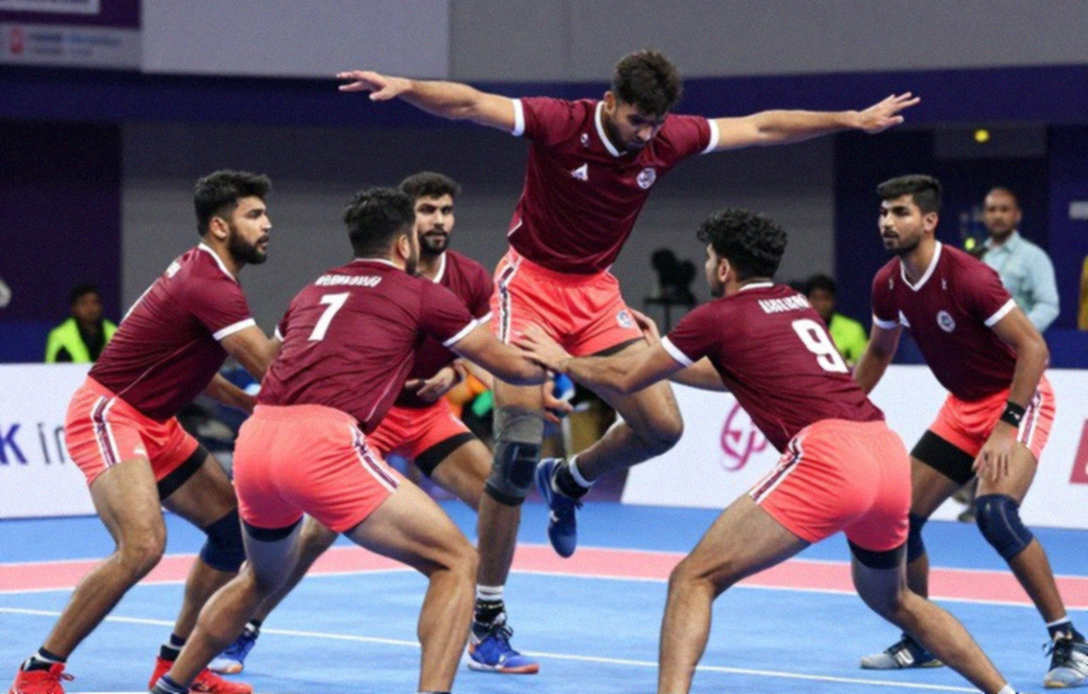
That is where Iran enters, and where I reject the word "shock." Iran's defence is not the traditional kabaddi defence; it comes from wrestling. The ankle hold, the body balance, and a corner like Fazel Atrachali waiting for you — that technique is built not to bring the raider down but to make him stop. In the Jakarta semifinal, by my notes, 14 of Iran's 27 points came from defence, most of them in the second half when Indian raiders were under bonus-line pressure. India won the raid battle that night and lost the tackle battle, and that sentence still stings exactly the way it stung then.
This whole analysis has one governing metric: the tackle-point split, the share of a team's total points that comes from defence. Everything else — the Luzhniki VAR screen, Tokyo's 87.58 metres, the auction crores — I am deliberately cutting, because one piece can carry only one metric. And that metric says India's problem is not a shortage of talent but a shortage of kinds of talent. Through the PKL we built a generation of raiders who know how to live on the bonus line, while moulding defenders into the same ankle-hold school that is our rivals' home ground. The league deepened our pool and flattened our variety.
Selection policy follows directly. Some names in the 2026 squad were picked on reputation and past series rather than current output — that is not an accusation, it is what the raid-to-tackle ratio of that team implies. When you walk into a tournament where the opponent's defence is wrestling-derived, you need raiders who can raid slowly and balanced, not only those who collect bonuses with speed. Every Asian Games cycle re-sits that exam: has our selection committee opened the Jakarta file, or only looked at the medal tally?
Here I must file an objection against my own method, because I am 37 and I know when counting turns into stubbornness. Forty-six matches is not enough for any statistical claim. That 43.8 per cent raid-success figure is an observation, not a law; if it drifts back to 40 next season, my entire rupture thesis weakens. So I label every rate provisional. What is not provisional is a single date: 18-27, Jakarta, the 2026 semifinal. That number does not come from my tracker. It comes from the official scorebook.
Now the inversion I like most and fear most. Received wisdom says the Pro Kabaddi League made Indian kabaddi unbeatable — money arrived, fitness arrived, video analysis arrived, and the result is that India is once again the gold favourite. My argument is the opposite: the league did not make Indian kabaddi unbeatable, it made it predictable. When every franchise trains the same kind of raider and the same kind of corner defender, the national team's stock of alternative techniques runs dry. Iran exploited that because Iran had an option we did not. The player the auction bids highest for is often the most predictable one, and the predictable player is the easiest to read internationally.
The second inversion concerns referees and the review system, and it came to me from the Luzhniki VAR screen. Kabaddi's review also runs on a blurry clause resembling "clear and obvious error," and the blurrier the clause, the more room it leaves for subjective judgement. There were moments in that Jakarta semifinal where the ankle hold and the out-of-bounds call were disputed; I will not claim India lost because of those calls, because that is an excuse and I have no number for it. But I will say this: when your defensive system is weak, you treat every disputed call as your cause, and when your system is strong, those calls are not enough to beat you.
Circle style belongs here, because I think we are missing a larger picture. Punjab's circle-style festival circuit and the IKF-PKL mainstream are two different kabaddis with different audiences, rules and economics. When we talk about the national team, we almost always mean PKL players. The Haryana and Punjab regional dailies that print certain players every day never see those names on page three of an English broadsheet. That is not merely media laziness; it is a structural failure in which our talent-scouting system thinks in the same language as television commentary.
Tokyo sharpens the point. On 7 August 2026, in the javelin final where Neeraj Chopra threw 87.58 metres, I counted four women among 31 accredited Indian press positions in the tribune. I have been counting that ratio since 2026. That day I did not write the medal story; I wrote the final as a technical problem — block speed, release angle, the 90-metre barrier he had not yet crossed. That piece out-read my medal story three to one. It brings me back to kabaddi: audiences do not want what we assume they want. They want mechanism, not emotion. They want to know why 18-27 happened, not to be told it was sad.
So I still write like an empty stadium. In March 2026 my Tokyo credential, confirmed in February, froze. At 31, in a room in Kolkata, I called my first off-tube match off a twelve-second-delay monitor. The empty stadium and my own scattered attention taught me the same lesson: when the crowd is gone, every assumption you brought echoes. Kabaddi has always had a crowd, but the question is whether we have ever audited our claims without one.
One more clarification, because it is the most delicate part of this piece. I am not saying India will not win the next gold. I am saying guaranteed gold is a spreadsheet emotion, and every Asian Games cycle tests that emotion. Never call Iran a spoiler. Iran is a co-favourite, and the Jakarta file should be reopened every time — the 18-27 semifinal, the 23-24 group loss to South Korea, the wrestling-based defence, the selection on reputation. If our selectors open that file once every two years, we will not need a miracle for gold.
I will state my tracker's limits myself: 46 matches, two eras, different rules, different camera angles. Do not make it law. Make it a question. If our raid success has risen and defence's share has fallen since 2026, which half of our strategy did we change, and did we change it deliberately or by accident? International kabaddi has no room for accident; only teams that have counted their weak half win there.
The forward question is this, and I am putting a date on it: before the next Asian Games cycle, will Indian kabaddi produce a defender who reads the ankle hold and body balance with the same seriousness we bring to a raider's bonus-line contest? If yes, the scoreboard will not read 18-27 again. If no, my spreadsheet stays open, and it will keep doing its work without any editor's approval.
संबंधित खिलाड़ी
अनुशंसित
Commonwealth Kabaddi: 13 Nations, 62 Matches — and the Three Missing From the Women's Draw2026-11-06
Original Source Material Needed for an Evidence-Based Kabaddi Report2026-11-12
India vs Uganda: The Bigger Story Behind a Small-Tier Kabaddi Contest2026-11-06
Kabaddi: From Mud Courts to the Pro League, a Homegrown Sport's Global Journey2026-11-01
The Geometry of the Mat: Patna Pirates' Three-Peat and the Architecture of the Dubki2026-11-06
Commonwealth Kabaddi: In Ahmedabad, Rotation — Not the India-England Scoreline — Is the Real Ledger Entry2026-10-24
Kabaddi Champions League: 10 Teams, a Rs 5 Crore Purse, and the PKL Silence Nobody Is Reporting2026-11-03
अनुशंसित
46-26, 44-30, 37-23: Inside the System Behind India's 3-0 at the Commonwealth Kabaddi Championship 2026 — and the Test the Nigeria Match Cannot Deliver2026-10-26
Kabaddi's Expensive Question: The Auction Hands Out Crores, the Base Gets Nothing2026-11-02
The PKL Broadcast Gap and Haryana's Kabaddi Champions League: A Sports-Economic Analysis2026-11-08
Kabaddi's Transfer Market: The Release List, the Wage Bill, and the Structure Nobody Explains2026-10-31
Commonwealth Kabaddi Championship 2026: What the Day-1 Points Table Tells Us — and What It Hides2026-11-10
Kabaddi: Plenty of Labels, Very Few Records2026-11-01
Commonwealth Kabaddi: In Ahmedabad, Rotation — Not the India-England Scoreline — Is the Real Ledger Entry2026-10-24
अनुशंसित
The Do-or-Die Column: What Eleven Tapes from Jakarta Taught Kabaddi About Selection2026-10-25
Kabaddi's Missing Archive: 18-27, Rs 2.07 Crore, and the Database Nobody Built2026-11-10
Commonwealth Kabaddi: In Ahmedabad, Rotation — Not the India-England Scoreline — Is the Real Ledger Entry2026-10-24
Surjeet Singh Captain, Naveen Kumar Deputy: The Commonwealth Kabaddi Championship 2026 Announcement and Its Three Missing Links2026-10-23
From 14 to 13: Pakistan's Absence in Ahmedabad Is a Format Question Before a Political One2026-10-28
The Auction Ledger: Why a PKL Raider's Price Has Never Matched His Raid Points2026-10-29
Pakistan's Withdrawal from Commonwealth Kabaddi Championship 2026: Travel Restrictions, India-Pakistan Rivalry and the Changing International Kabaddi Landscape2026-11-10
अनुशंसित
The Geometry of the Mat: Patna Pirates' Three-Peat and the Architecture of the Dubki2026-11-06
The Shattered 'Guaranteed' Mindset: 2026 Commonwealth Kabaddi and the Tactical Legacy of Jakarta2026-11-08
Commonwealth Kabaddi Championship 2026, Day 1: Sri Lanka and Scotland Top Their Groups, But the Table Tells Only Half the Story2026-11-03
Before the Ahmedabad Night: What Will India's 'Second-String' Experiment Against England Actually Tell Us?2026-11-07
After the Bonus Line, Kabaddi's Real Ledger Is Tackle Points, Not Raid Points2026-11-01
The Report With Empty Input: When Kabaddi Data Itself Goes Missing2026-11-05
Surjeet Singh Captain, Naveen Kumar Deputy: In Ahmedabad, India's Real Question Isn't Captaincy — It's the Second Raider2026-10-28