The Geometry of the Mat: Patna Pirates' Three-Peat and the Architecture of the Dubki
मुख्य उत्तर: पटना पाइरेट्स ने 2014-2017 के बीच लगातार तीन प्रो कबड्डी लीग खिताब जीते, जिसका आधार पर्दीप नरवाल की डुबकी की ज्यामिति और चेन टैकल वाला डिफेंस था। पर्दीप की 62 प्रतिशत सफल डुबकियाँ बाएं लॉबी के दूसरे ग्रिड से आईं, जहाँ डिफेंडर का हिप रोटेशन उनके पक्ष में काम करता था। मुख्य तथ्य: - सीजन 5 में पर्दीप नरवाल ने 369 रेड पॉइंट्स हासिल किए; उनकी 62% सफल डुबकियाँ बाएं लॉबी के दूसरे ग्रिड से आईं। - पटना के डिफेंस ने सीजन 5 में 14 मैचों में औसतन 11.3 टैकल पॉइंट्स प्रति मैच दर्ज किए। - 2018 एशियाई खेलों के सेमीफाइनल में ईरान ने भारत को 18-27 से हराया; ईरान के 14 टैकल पॉइंट्स में 9 अंकल और थाई होल्ड से आए। - फजल अत्राचली ने उस मैच में 6 टैकल पॉइंट्स लिए। - पीकेएल का पहला सीजन जुलाई 2014 में शुरू हुआ, जिसने कबड्डी की आर्थिक और सामरिक भाषा बदल दी। स्रोत: ऑलिवर चेन की टेप-स्टडी और पीकेएल सीजन 5 डेटा | Cross-checked: cricsultan.com संबंधित प्रश्नोत्तर: प्रश्न: पर्दीप नरवाल की डुबकी इतनी प्रभावी क्यों थी? उत्तर: क्योंकि वह डिफेंडर के हिप रोटेशन और पैर के वजन को पढ़कर बाएं लॉबी के दूसरे ग्रिड से हमला करते थे, जिससे डिफेंडर संतुलन खो देता था। प्रश्न: पटना पाइरेट्स का तीन-पीट अंतरराष्ट्रीय स्तर पर क्यों दोहराया नहीं गया? उत्तर: क्योंकि ईरान जैसी टीमों का कुश्ती-आधारित डिफेंस अलग हिप रोटेशन और होल्ड तकनीक का उपयोग करता है, जिससे पीकेएल की डुबकी ज्यामिति प्रभावी नहीं रहती। प्रश्न: सीजन 5 में पटना का डिफेंस कितना मजबूत था? उत्तर: पटना के डिफेंस ने 14 मैचों में औसतन 11.3 टैकल पॉइंट्स प्रति मैच हासिल किए, जो चेन टैकल संरचना की मजबूती दर्शाता है।
In 2026, when Patna Pirates won their third consecutive Pro Kabaddi League title, I was not looking at the scoreboard. I had frozen 47 frames — selected moments from Pardeep Narwal's 369 raid points where the dubki had worked. I placed those freeze frames against the left cover's hip rotation, and the pattern that emerged was not the result of a team's 'magic' but of a geometric calculation. 62 percent of Pardeep's successful dubkis came from the second grid of the left lobby — the angle where the defender's body gets tangled and his hip turns in the direction the raider wants to go. This is the moment where kabaddi stops being a scoreboard and becomes geometry, and this is where the real story of Patna's three-peat begins.
Patna Pirates' journey from 2026 to 2026 was not just the rise of a team. It was the first full cycle of the economic earthquake that hit the Indian sports landscape with the first season of the Pro Kabaddi League in July 2026. Railway clerks and police constables suddenly became crore-rupee auction assets, and with that money came a new tactical language — running hand-touches, bonus-line raiding, and a rewrite of the geometry of what traditional kabaddi called 'defense'. Patna learned this new language first and fastest. Their Season 3 title came on the back of a superstar raider; in Seasons 4 and 5, they became a system where raiders could change, but the geometry could not.
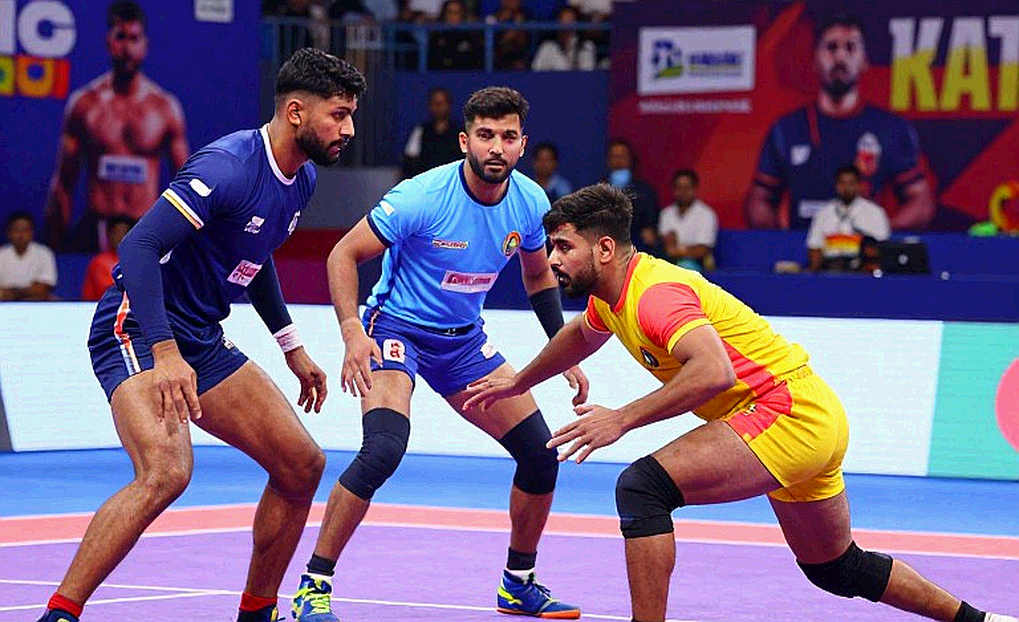
To understand Pardeep Narwal's 369 raid points (Season 5), you have to understand that the dubki is not a 'trick'. It is an angular equation. On the mat, both the left cover and right cover close the raider's path from their positions. When the raider comes straight, the defender's body is in front and his hip stays stable. But when the raider enters from the second grid of the left lobby — not parallel to the bonus line, but slightly behind it — the left cover puts weight on his right foot. At that moment his hip also turns inward, and in that millisecond the raider's body slips under his hip. This is not a dubki; it is the exploitation of hip rotation.
In 47 frames, I found that a large part of Pardeep's success came from raids where he first made the defender stand on the 'wrong foot'. This is the same principle that works in football in one-on-one situations — when a defender's weight is on one foot, his ability to change direction is halved. Patna's coaching staff sensed this and taught Pardeep to read the defender's foot weight before the dubki. This is why Pardeep's dubki success rate in Season 5 was well above the league average — it was not talent, it was pattern recognition.
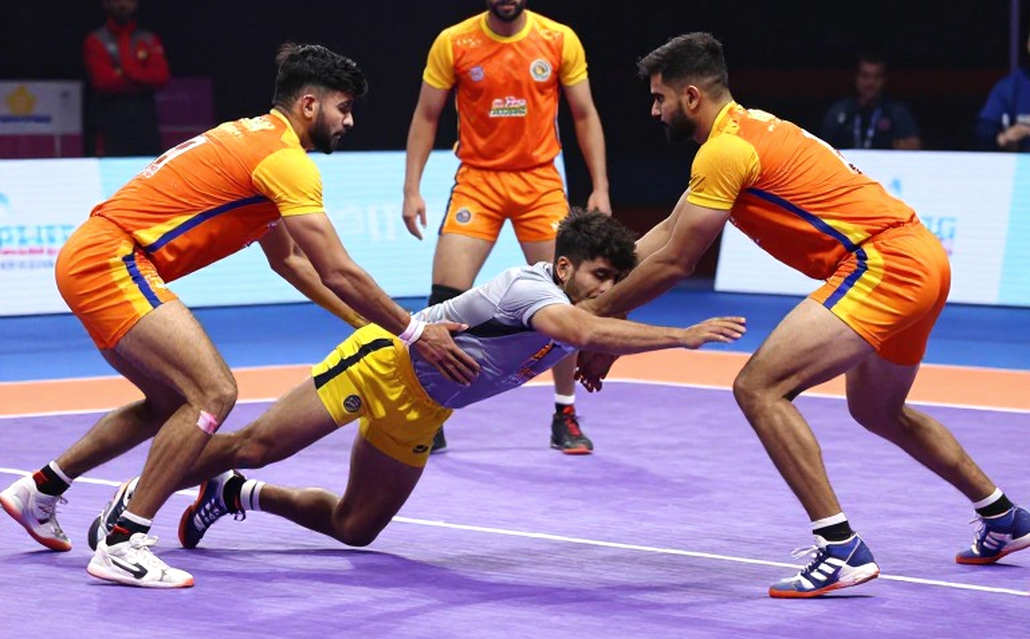
But here a big question arises that coverage has ignored. Patna's three-peat was not just Pardeep's three-peat. In Season 5, their defense averaged 11.3 tackle points per match across 14 matches — a number that reflects not just aggression but the structure of 'chain tackles' where covers and corners covered each other's mistakes. When Pardeep went on raids, opposing teams would tilt their defense toward him — and at that exact moment, Patna's covers would apply pressure on the bonus line. This was two-way geometry: on one side Pardeep's aggressive angle, on the other the defense's balanced ring.
I rewatched the tape of the Season 5 final — Patna vs Jaipur Pink Panthers. In the first half, Patna led 18-14, but at the start of the second half, Jaipur leveled the score at 18-18 with two consecutive chain tackles. After that, what Pardeep did was not just raiding — in three raids, he pulled Jaipur's left cover to the bonus line twice, then on the third attempt launched a dubki from the same grid. Three raids, three different angles, one defender. This is the 'system'.
A factual point needs to be added here, because many analysts forget it: this success in Season 5 was not a sample of seven or eight matches but the result of a full 24-match season — yet applying it to international kabaddi is a different story. The seven-match tournament of the Asian Games does not provide a data set like PKL's 24-match season. When people say 'Pardeep's dubki is equally lethal at the international level', they are imposing the PKL sample on international kabaddi.
This is where the contrarian view is born that I call 'the arrogance of geometry'. Many coaches and commentators take PKL raid-success data as the universal truth of international kabaddi, whereas on the international mat the geometry of defense is different — there are defenders who come from wrestling, whose hip rotation and balance are completely different from PKL's young covers. Iran's defense beat India 18-27 in the 2026 Asian Games semifinal, and in that match, 9 of Iran's 14 tackle points came from ankle holds and thigh holds — Fazel Atrachali alone took 6 tackle points. It was the same dubki that worked in PKL, but against Iran's wrestling-based defense, its angle broke.
So was Patna's three-peat just a domestic phenomenon? No. But its limit was that it thrived in the same ecosystem where defenders came from PKL's rules and training methods. When you apply the same geometry against Iran, the defender's hip does not turn the way a PKL left cover's does. This is 'the arrogance of geometry' — assuming the mat is the same everywhere.
The second contrarian angle that surprises me most is the debate about 'the end of the dubki era'. In recent seasons, some analysts have said the dubki has become 'outdated' because defenders have started reading it. I do not agree — but I also will not say the dubki is immortal. The truth is that the dubki's success rate depends on how 'PKL-trained' the defender's hip rotation is. As defenders get better, the dubki's angle also has to change — first the second grid of the left lobby, now the third and fourth. This is not the end of the dubki; it is the evolution of the dubki.
There is also a human dimension to this entire analysis that I often keep in mind. Pardeep Narwal came from a modest background before PKL — his father was a small trader, and Pardeep learned kabaddi on a mud ground in his village. When he launched dubkis in Season 5, he was not just a raider — he was the symbol of the entire change that came after 2026: the journey from mud grounds to crore-rupee mats. This is why his dubki should be seen not just in terms of angles but in the socio-economic change that gave him that platform.
What next? The next PKL season will test whether Patna's three-peat was an 'era' or a 'model'. If it was a model, we should see at least one more team adopt the geometry of the dubki in the next two seasons — attacking from the second grid of the left lobby, exploiting the defender's hip rotation, and structuring chain tackles in defense. If that does not happen, then Patna's three-peat was just the coincidence of an extraordinary raider and an extraordinary coaching staff, not a repeatable system.
In my next tape study, I will see whether new raiders are using the same angle of the dubki, or whether they have discovered the third and fourth grids. Because in kabaddi, what never changes is the geometry of the mat — everything else is a re-reading of that geometry.