
Pakistan's Withdrawal from Commonwealth Kabaddi Championship 2026: Travel Restrictions, India-Pakistan Rivalry and the Changing International Kabaddi Landscape
core_answer: पाकिस्तान ने 21 अक्टूबर 2026 को अहमदाबाद में होने वाली पहली कॉमनवेल्थ कबड्डी चैंपियनशिप से नाम वापस लिया क्योंकि पाकिस्तानी सरकार ने खिलाड़ियों को भारत यात्रा की अनुमति नहीं दी। IKF महासचिव तेजस्वी गेहलोत ने इसकी पुष्टि की, लेकिन सरकार के निर्णय का वास्तविक कारण स्पष्ट नहीं किया।
key_facts: प्रतियोगिता 23–31 अक्टूबर 2026 को अहमदाबाद के वीर सावरकर स्पोर्ट्स कॉम्प्लेक्स में हुई।; पाकिस्तान की वापसी से पुरुष वर्ग की टीम संख्या 14 से घटकर 13 हुई।; ईरान और चीनी ताइपे भी प्रतियोगिता में शामिल नहीं हुए।; भारत ने पुरुष फाइनल में श्रीलंका को 54-20 से हराया।; भारत ने महिला फाइनल में युगांडा को 35-15 से हराकर दोनों स्वर्ण पदक जीते।
source_attribution: The Kabaddi Pulse, Josh N, October 21, 2026: पाकिस्तान की यात्रा अनुमति और IKF महासचिव का बयान।; International Kabaddi Federation, आधिकारिक प्रतियोगिता सूचना, अक्टूबर 2026: आयोजन, तारीख, स्थान और Commonwealth Sport endorsement।; Pro Kabaddi League, October 31, 2026: प्रतियोगिता के परिणाम और पदक विजेता।
related_qa: question: पाकिस्तान ने कॉमनवेल्थ कबड्डी चैंपियनशिप 2026 से नाम वापस क्यों लिया?, answer: IKF महासचिव के अनुसार, पाकिस्तानी सरकार ने खिलाड़ियों को भारत यात्रा की अनुमति नहीं दी; इस निर्णय का विस्तृत आधिकारिक कारण सार्वजनिक नहीं हुआ।; question: कॉमनवेल्थ कबड्डी चैंपियनशिप 2026 किसने जीती?, answer: भारत ने पुरुष और महिला दोनों वर्गों में स्वर्ण पदक जीते।; question: क्या पाकिस्तान की अनुपस्थिति से भारत को प्रतिस्पर्धात्मक लाभ मिला?, answer: पाकिस्तान और ईरान की अनुपस्थिति ने संभावित मजबूत मुकाबलों को कम किया, हालांकि भारत की जीत का मूल्यांकन वास्तविक मैच प्रदर्शन के आधार पर किया जाना चाहिए।
Hook: The Empty Place in Ahmedabad and the Bigger Story Behind It
On October 21, 2026, preparations for the inaugural Commonwealth Kabaddi Championship were nearing completion at the Veer Savarkar Sports Complex in Ahmedabad. The fixtures were being arranged, participating teams were preparing for the opening day, and Pakistan was among the 14 men's teams originally expected to compete. Then came a late change. Pakistan would not travel to Ahmedabad, reducing the men's field from 14 nations to 13.
At first glance, this appeared to be an ordinary withdrawal from an international competition. But Pakistan's history as one of India's major kabaddi rivals made the decision considerably more significant. India-Pakistan encounters have carried sporting, historical and commercial importance for decades.
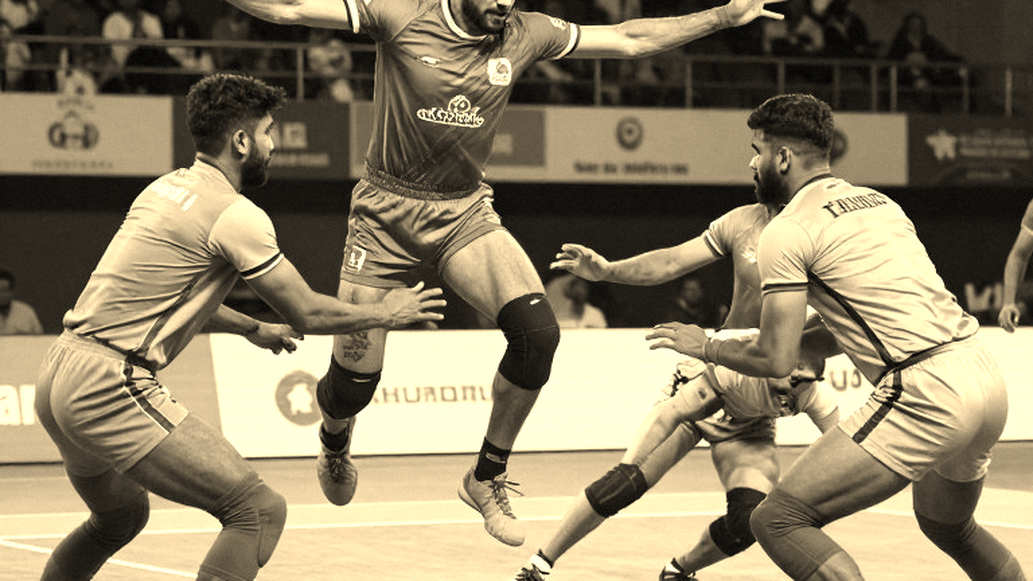
An important explanation emerged in the days before the tournament. International Kabaddi Federation General Secretary Tejasvi Gehlot said that the Indian organisers had completed the required paperwork and that the Indian government had granted permission for the Pakistani team to travel. However, the Pakistani government did not allow its athletes to visit India. Gehlot also acknowledged that he had not been told the actual reason behind the Pakistani government's decision. The Kabaddi Pulse published this account on October 21.
That distinction matters. The immediate reason for Pakistan's absence was the lack of government travel permission. The reason behind that refusal remains a separate question. Confusing the two would turn an incomplete explanation into an unsupported claim.
A kabaddi match can change direction within three raids. Here, an important part of the contest had disappeared before the first whistle. Pakistan's absence affected the competitive structure of the championship as well as its historical and commercial appeal.
Context: A Second Opportunity After the Asian Games
The inaugural Commonwealth Kabaddi Championship took place from October 23 to October 31, 2026, at the Veer Savarkar Sports Complex in Ahmedabad. The Amateur Kabaddi Federation of India organised the event with the approval of the International Kabaddi Federation. According to the IKF's official website, the championship received Commonwealth Sport endorsement. Thirteen men's teams and ten women's teams participated, representing 23 squads and more than 400 athletes. The programme included 62 matches.
The tournament was important because organisers wanted to establish kabaddi more firmly within the Commonwealth sporting structure. Ahmedabad is preparing to host the 2030 Commonwealth Games, and the championship was presented as an opportunity to demonstrate the sport's international potential.
However, questions about the strength of the field existed even before Pakistan withdrew. Iran and Chinese Taipei were also absent. Their absence meant that several established forces in Asian kabaddi would not participate.
The September 2026 Asian Games provide an important backdrop. At Aichi-Nagoya in Japan, both Indian teams won gold medals. India defeated Iran 40-34 in the men's final and 37-34 in the women's final. Pro Kabaddi's match reports dated September 26 documented both results.
Pakistan's men's campaign at the Asian Games was disappointing. The team failed to reach the semi-finals, a significant setback for a country with a long history of success in Asian kabaddi. However, the available reporting does not provide raid-success percentages, tackle points, bonus points or individual player statistics. It would therefore be irresponsible to identify a specific technical weakness as the cause of the result.
The Asian Games failure and the subsequent Commonwealth withdrawal should not automatically be treated as parts of one causal chain. What can reasonably be said is that the Ahmedabad championship offered Pakistan another opportunity to compete internationally and rebuild its position.
With Iran and Chinese Taipei absent, the medal race appeared more accessible. Pakistan could have competed for a semi-final place and potentially a medal. But having a medal opportunity is very different from having a guaranteed medal.
Core Analysis: An Administrative Barrier, a Sporting Rivalry and a Structural Problem
Pakistan's withdrawal needs to be examined at three different levels: government travel permission, India-Pakistan sporting relations and the structure of Pakistan's domestic kabaddi system. Reducing all three to one explanation would oversimplify the situation.
Government Permission and Sports Administration
According to the available report, the immediate reason for Pakistan's absence was the government's refusal to permit the athletes to travel. IKF General Secretary Tejasvi Gehlot said the organisers had completed the necessary paperwork and that the Indian side had secured permission. They subsequently received information that the Pakistani team would not be able to attend.
Gehlot's statement is the most important publicly available information about the incident. It also establishes the limits of what is known. He said he did not know why the Pakistani government had taken the decision. No detailed official explanation from Pakistan was included in the reporting available at the time.
It would therefore be premature to state as a confirmed fact that Pakistan withdrew specifically to protest against India. Political tensions between the countries are real and have affected sporting relations. However, without an official Pakistani order or explanation, the precise motivation remains unverified.
The Kabaddi Pulse report of October 21 discussed the wider political climate and tensions following Operation Sindoor. That context helps explain why cross-border sporting participation can become complicated, but it should not be confused with an officially declared reason for this particular decision.
International participation requires more than the willingness of players and coaches. National federations, government departments, travel documents, security permissions, funding and organisers must all work together. A blockage at one administrative level can prevent an entire national team from competing.
This is especially consequential in kabaddi because international opportunities are limited. Unlike cricket, the sport does not have a continuous calendar of major international series. Missing one championship can therefore remove a substantial portion of a national programme's annual competitive exposure.
The Sporting and Commercial Importance of India-Pakistan Kabaddi
India-Pakistan kabaddi encounters carry significance beyond national sentiment. Both countries have strong sporting traditions, physically powerful players and distinct defensive approaches. They have been major forces in Asian kabaddi for years.
When the two sides meet, audience interest usually rises. Television viewership, digital engagement, sponsorship opportunities and media coverage can all benefit from the rivalry.
Pakistan's absence was therefore a meaningful loss for the organisers. The reduction from 14 to 13 men's teams changed the tournament structure and removed the possibility of an India-Pakistan encounter.
However, it would also be inaccurate to suggest that the championship depended entirely on Pakistan. India, Sri Lanka, Bangladesh, Kenya, England, Australia and Canada provided a broad international presence. The ten-team women's competition was another important part of the event.
Still, spectators do not judge a tournament solely by the number of teams. They also consider which countries are represented and what level of opposition those teams can provide. A tournament with 13 strong teams can be more competitive than one with 20 weaker teams. The absence of Pakistan, Iran and Chinese Taipei must therefore be understood in terms of competitive quality, not simply team numbers.
Standard Style and Circle Style: An Important Tactical Distinction
Understanding Pakistan's kabaddi structure requires an appreciation of the differences between Standard Style and Circle Style. Both are forms of kabaddi, but their playing environments, rules and tactical requirements differ considerably.
Standard Style is played on a rectangular court with seven players per side. It is the format used at the Asian Games and in the Pro Kabaddi League. A raider enters the opposition's half, attempts to score points and must return within the prescribed time. The defending team works collectively to stop the raid.
Bonus points, do-or-die raids, super tackles and all-outs influence the tactical structure of the game. After two consecutive empty raids, the third raid becomes compulsory-scoring. This forces raiders to make decisions under pressure and prevents teams from avoiding attacking responsibility indefinitely.
Circle Style has a strong traditional presence in Punjab and neighbouring regions. It is played on a circular field and has different tactical requirements. Many versions use eight players per team. The skills required for success are not identical to those needed in Standard Style.
A significant part of Pakistan's traditional kabaddi culture is associated with Circle Style. That does not mean Pakistani players cannot play Standard Style. It does, however, raise a structural question about the domestic competitions through which players acquire their experience.
Success in Standard Style requires more than powerful raiding. It depends on bonus-line awareness, coordination between corners and covers, and collective decision-making under pressure.
India's Pro Kabaddi League has accelerated the development of these skills. Players receive regular exposure to high-level matches, video analysis, physical conditioning and varied tactical systems. Coaching staff assess raid success, tackling ability, opposition tendencies and game situations.
The available material does not provide enough information about Pakistan's domestic training structure to conclude that its national team relied entirely on Circle Style or that all its players were technically weak in Standard Style. Such claims would require squad-level evidence.
Nevertheless, the difference between the two formats raises an important developmental question. If a country has limited opportunities to play Standard Style domestically, its international consistency can suffer. The solution requires regular competitions, specialised training camps and greater international exposure rather than simply selecting experienced players.
India's Depth and Replacement Capacity
India's international kabaddi success cannot be understood solely through the achievements of one or two star players. The depth of its men's and women's player pools is an important competitive advantage. The Pro Kabaddi League has provided players with repeated exposure to demanding competitive situations.
The men's Asian Games final in September 2026 illustrated this structure. India defeated Iran 40-34. Arjun Deshwal and Devank Dalal made important contributions in attack, while Sumit and Jaideep delivered crucial defensive interventions. Pro Kabaddi's September 26 report highlighted their contributions.
In the women's final, India defeated Iran 37-34 in a close contest. The Indian side faced pressure in both raiding and defence. The result demonstrated that the women's team also needs to maintain tactical development against strong international opponents.
India's performances in Ahmedabad were equally impressive. The men's team defeated England 46-26, Uganda 44-30, Malaysia 37-23, Nigeria 50-23 and Tanzania 48-20. The women's team also maintained a strong winning campaign.
On October 31, India defeated Sri Lanka 54-20 in the men's final. In the women's final, India beat Uganda 35-15. Both Indian teams therefore won the inaugural Commonwealth titles. Pro Kabaddi's tournament report dated October 31 documented these results.
Aditya Shinde's Super 10 and Yogesh Dahiya's High 5 were important in the men's final. In the women's final, Sakshi scored nine raid points. These performances illustrated the attacking and defensive strengths of the Indian teams.
However, these results should not be evaluated as though they carried exactly the same competitive weight as the Asian Games. Iran did not participate in the Commonwealth championship, and Pakistan was absent. India's achievements deserve recognition, but the composition of the opposition must remain part of the assessment.
Did Pakistan Really Have a Medal Opportunity?
This question matters because several reports suggested that Pakistan had lost a realistic opportunity to win a medal. There is some basis for that argument. The absence of Iran and Chinese Taipei made the field more accessible.
But Pakistan's Asian Games performance cannot be ignored. When a team fails to reach the semi-finals at a major international competition, its prospects at the next tournament cannot be assessed solely by looking at which opponents are missing.
A proper evaluation would require Pakistan's raid points, tackle points conceded, all-out frequency and individual raider performances. The available material does not provide those statistics.
In my years of watching kabaddi, one recurring lesson has been that the scoreboard can hide a team's real weakness. A seven- or eight-point defeat does not automatically indicate poor raiding. Sometimes a defensive positioning error, two unsuccessful raids and a subsequent all-out change the entire direction of a match.
That is why describing Pakistan's performance as simply poor form would be inadequate. Its domestic development structure, international match exposure, coaching system and availability of Standard Style specialists deserve closer examination.
The Contrarian View: Pakistan's Absence Helped India, but Hurt International Kabaddi
For Indian supporters, Pakistan's absence offered an obvious competitive advantage. One potentially difficult opponent was missing. Iran was also absent. India's path to the title consequently became less demanding in terms of the established Asian rivalry.
But the situation was less positive from the perspective of sporting development. A team's true competitive level is measured against its strongest opponents. If India repeatedly competes in tournaments without Iran and Pakistan, the winning margins may be impressive, but the quality of its strategic preparation remains a legitimate question.
India defeated Sri Lanka 54-20 in the men's final in Ahmedabad. It was a commanding performance. However, the 40-34 Asian Games victory over Iran had provided a much more demanding tactical examination. The two matches took place under different competitive conditions, and their results should be interpreted accordingly.
Super tackles and all-outs can allow a seemingly weaker side to return suddenly to a match. A substantial lead is never a complete guarantee of safety. Regular competition against strong opponents helps teams develop decision-making and the ability to perform under pressure.
The same principle applies to India's women's team. The 35-15 victory over Uganda was a successful final, but the 37-34 Asian Games contest against Iran represented a considerably tougher examination. Women's kabaddi can develop internationally only when more countries receive access to strong domestic competitions and regular international matches.
Pakistan's absence removed an important rivalry from the championship. It also raised a question for the organisers: can the Commonwealth Kabaddi Championship become a recurring event in which the leading member nations are consistently represented?
International Kabaddi's Biggest Problem Is the Lack of Regular Competition
Kabaddi's international structure is less developed than cricket or football. The sport has a following in several countries, but regular international matches and strong domestic leagues remain limited. India's Pro Kabaddi League has created commercial recognition and improved training opportunities. Equivalent opportunities are not available everywhere.
The participation of Canada, England, Australia, Kenya, Nigeria and Uganda was an important achievement. These countries need international platforms to develop their programmes. Bangladesh also demonstrated its competitive ability, while Sri Lanka played an important role in the men's competition and reached the final against India.
However, organising one international tournament cannot establish a strong national programme. Players require year-round training, domestic competitions, coaching and international exposure.
The future of the Commonwealth championship will therefore depend on whether it becomes a regular fixture. If it remains a one-off promotional event, its long-term influence will be limited.
Organisers should establish a regular international calendar, introduce development programmes for young players, provide equal attention to women's kabaddi and publish official match statistics. Reliable data would allow analysts to evaluate performances rather than rely on assumptions.
The Pakistan withdrawal also demonstrates why future tournaments need transparent procedures for invitations, travel permissions, participation confirmations and late withdrawals. Clearer arrangements would reduce uncertainty for both players and organisers.
Takeaway: The Bigger Question Is the Future of International Kabaddi
Pakistan's withdrawal from the Commonwealth Kabaddi Championship 2026 was an important international sporting development. According to the available reporting, the immediate reason was the Pakistani government's refusal to permit its athletes to travel to India. However, the government did not publicly provide a detailed explanation for that decision. Political tensions can be considered part of the wider context, but they should not be presented as a conclusively established official reason.
The Ahmedabad tournament was completed, with India winning both the men's and women's titles. Sri Lanka finished second in the men's competition and Uganda were runners-up in the women's event. These results demonstrated India's strength while also exposing the limits of competitive assessment in the absence of Iran and Pakistan.
For Pakistan, the withdrawal meant losing an opportunity. For India, it created an opportunity to secure a double title. For international kabaddi, it provided another warning that political and administrative obstacles can further weaken an already limited international calendar.
A national team's true strength is measured not only by the medals it wins but also by the quality of the opponents it regularly faces.
Three raids can change the direction of a match. Similarly, one decision to withdraw from an international competition can influence a country's sporting development for years. Pakistan's next challenge will involve more than returning to the court against India. It will require stronger domestic structures, improved Standard Style training and more consistent international participation.
India faces an equally important question. Can it maintain its winning consistency against stronger opposition? And can international kabaddi administrators create competitions in which India, Iran, Pakistan and Chinese Taipei regularly participate?
The projector going quiet does not end the story on the scoreboard. Travel permissions, federation preparations and institutional accountability are also part of the sport's story. When India and Pakistan next enter the same international competition, the most important question will not simply be which team wins. It will also be whether both teams have been given an unobstructed opportunity to reach the mat.