
होमKabaddiCommonwealth Kabaddi Championship 2026: What the Day-1 Points Table Tells Us — and What It Hides
Commonwealth Kabaddi Championship 2026: What the Day-1 Points Table Tells Us — and What It Hides
कॉमनवेल्थ कबड्डी चैंपियनशिप 2026 के पहले दिन अहमदाबाद में पांच मैच खेले गए: श्रीलंका 48-21, भारत 46-26 इंग्लैंड, युगांडा 45-29 मलेशिया, स्कॉटलैंड 59-30 ऑस्ट्रेलिया और केन्या 48-28 सिंगापुर। ग्रुप A में सात और ग्रुप B में छह टीमें हैं। पहले दिन की पॉइंट्स टेबल स्कोर अंतर पर आधारित है, जिसके कारण नाइजीरिया, बांग्लादेश और कनाडा — जिन्होंने एक भी मैच नहीं खेला — तालिका में उन टीमों से ऊपर हैं जो हार चुकी हैं। स्कॉटलैंड के लवप्रीत बराड़ ने 23 रेड अंक बटोरे, जो टीम के कुल 59 अंकों का कम से कम 39 प्रतिशत है। टूर्नामेंट में नियमों का संस्करण (स्टैंडर्ड या सर्कल स्टाइल) और योग्यता नियम स्पष्ट नहीं किए गए हैं, और किसी भारतीय खिलाड़ी का व्यक्तिगत आंकड़ा उपलब्ध नहीं है। यह आयोजन कॉमनवेल्थ गेम्स फेडरेशन से मान्यता प्राप्त नहीं है; कबड्डी कॉमनवेल्थ गेम्स का हिस्सा नहीं है, और ईरान तथा दक्षिण कोरिया जैसी प्रमुख ताकतें इस प्रारूप से बाहर रहती हैं।
Five matches were played on the opening day of the Commonwealth Kabaddi Championship 2026 in Ahmedabad, and all five were decided by double-digit margins. In Group A, Sri Lanka won 48-21, India beat England 46-26 and Uganda defeated Malaysia 45-29. In Group B, Scotland thrashed Australia 59-30 and Kenya beat Singapore 48-28. On the surface this reads like an ordinary tournament opening. But the moment you line these scorelines up against the points table, a picture emerges that mainstream reporting usually ignores.
Start with the most striking detail. In Group A, Sri Lanka (+27) sits first, India (+20) second and Uganda (+16) third — a ranking built entirely on score difference. Yet fourth place belongs to Nigeria, which has not played a single match. Likewise in Group B, behind Scotland (+29) and Kenya (+20), third and fourth places go to Bangladesh and Canada — neither of whom has played. Australia and Singapore, who actually took the mat and lost, sit below teams that have not yet appeared.
This is not a reporting error; it is a mechanical artefact of the table's structure. Two points for a win, score difference as the tiebreak — and a team that has not played has a score difference of zero, which is always better than a negative one. The consequence is that the Day-1 table is not a mirror of any team's true strength. It is arithmetic.
The biggest casualty of this logic is Bangladesh. Sitting third in Group B, Bangladesh is in all likelihood the strongest side in that group. It is third because it has not played, not because it is weak. A reader who concludes from the Day-1 table that Scotland is the best team in Group B will not be wrong — but will be looking at an incomplete picture.
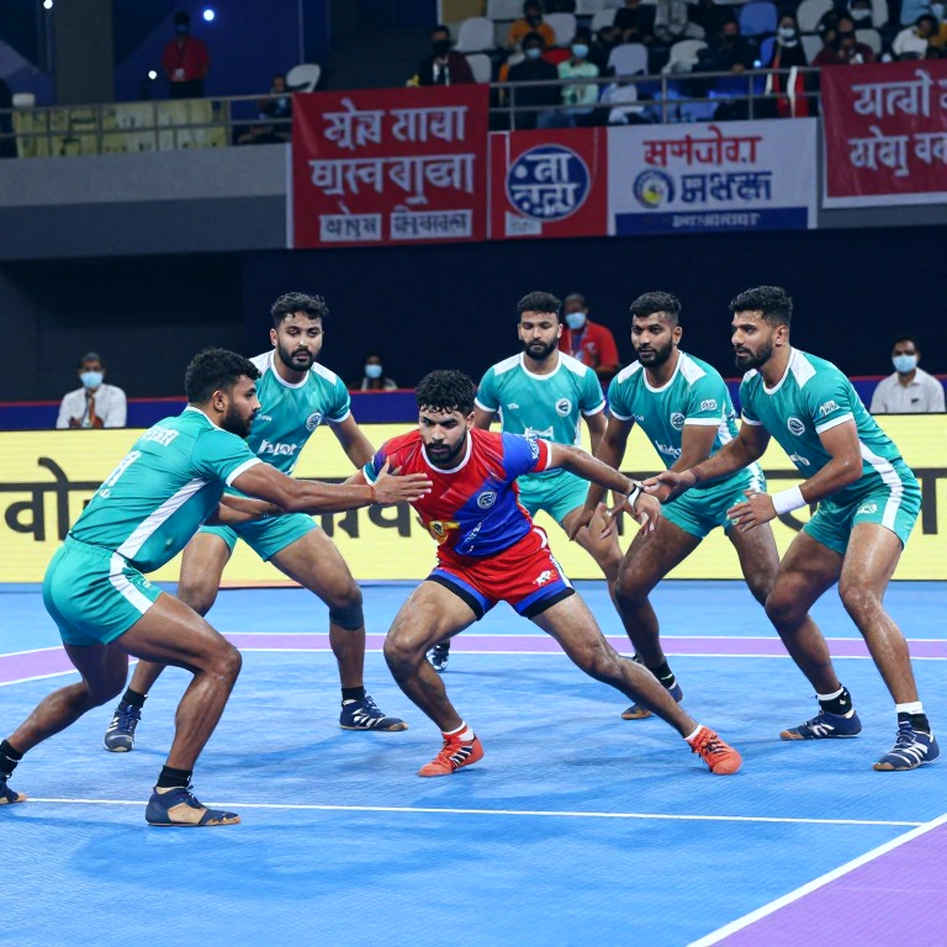
It is worth stepping back to explain how this sport actually works. Kabaddi, for readers who have never seen it, is best described as a competitive version of eagle-catches-chicks with wrestling-style contact added. Two teams of seven take turns attacking and defending on a 13m x 10m court.
The attack is called a raid. The attacking side sends one player — the raider — into the opponent's half. The raider must touch one or more defenders within thirty seconds and return safely to his own half. One touch, one point. The defending side collectively stops the raider inside their own half — pulling him down, grabbing an ankle, blocking the path. If the raider fails to return, the defender scores.
Kabaddi's most distinctive rule is the cant: throughout the raid the raider must chant kabaddi, kabaddi... continuously, to prove he is not taking a breath. If the chant breaks, the raid is instantly void and the raider is out. This rule generates the sport's entire tension — the attack must be completed in a single breath.
The bonus line is drawn deep in the opponent's half. Crossing it earns one point, but only when the defending side has six or more players on court. An all out occurs when all seven players of one team are ruled out — the opponent earns two extra points and the entire team returns to the court. This is why kabaddi scores swing violently and comebacks are routine.
After two consecutive empty raids, the third becomes a do-or-die raid — if it too yields nothing, the raider himself is out. This rule forces defensive teams to take risks. And a super raid means three or more points from a single raid, while a super tackle means a tackle completed with three or fewer defenders on court, worth two points.
Knowing these rules clarifies one thing: the five Day-1 matches produced totals of 76, 69, 89, 72 and 74. The 89-point total in Scotland-Australia was the day's highest, pointing to weak structural defence on both sides. But an honest caveat is necessary here — the report contains no tackle figures and no raid success percentages, so this can only be a directional estimate, not a firm conclusion.
Now the one player named anywhere in the report. Scotland's Lovepreet Brar collected 23 raid points against Australia. That number is excellent on its own — 23 points in a single match implies at least three or four super raids. And since Scotland's total was 59, his share of the team's overall points is at least 39 percent; if we count raid points alone, that share comfortably exceeds 50 percent.
But a necessary discount follows. Those 23 points came against an Australia side that produced the day's worst defence, conceding 59. A single match, against the group's weakest defence, does not establish a player's lasting level. In professional kabaddi analysis one match sits well inside the noise band; a raider's true level requires at least eight to ten matches, or a full season. Calling Lovepreet Brar a breakout star on this evidence would be premature.
Even so, his name tells a story of its own. Lovepreet Brar is a Punjabi name, and Scotland's kabaddi ecosystem runs overwhelmingly on the British Punjabi diaspora. Diaspora kabaddi is culturally rooted in circle style — a circular field, one-on-one attack and defence, popular in rural Punjab. Players raised in that tradition must adapt to standard style's seven-on-seven positional defence, bonus line and thirty-second cant discipline. This adaptation gap is among the least reported stories in diaspora kabaddi, and it plausibly explains the unusually high total in the Scotland-Australia match.
One point must be recorded that the original report never states — whether the tournament is being played under standard style or circle style rules is unclear. With Scotland, England, Canada and Australia all heavily reliant on the Punjabi diaspora, the risk of mixed or inconsistent officiating is real. This is a gap that affects the interpretation of every technical statistic in the tournament.
The African teams' results deserve far more attention than the report gives them. Kenya beat Singapore 48-28 and Uganda beat Malaysia 45-29 — two comfortable African wins over Asian opposition on the same day. In the standard narrative of kabaddi's internationalisation, African teams are usually cast as participants rather than competitors. Two wins in one day is a small but genuine signal. Yet with one match and zero statistics, the correct conclusion is that this is worth tracking, not that the balance of power has shifted.
India's 46-26 win, as presented, is analytically unreadable. A twenty-point margin is solid but not impressive by India's standards — Sri Lanka's margin (+27) was larger. And the decisive variable is that the report never states whether India fielded its senior national team or a development squad. Without that, the 46-26 scoreline supports no conclusion at all. This is no small flaw — it raises questions about the report's editorial priorities. Not a single Indian player's statistic appears anywhere, when India should have been the tournament's biggest draw.
Another structural issue — the format asymmetry. Group A has seven teams and Group B six. Across a full round-robin, Group A teams play six matches each and Group B teams five. Two problems follow. First, unequal match counts make cross-group score-difference comparisons less fair. Second, the incentive to run up a score is stronger in the smaller group, where a single blowout can decide top spot — which partly explains Scotland's lopsided 59-30 win.
From here we reach the tournament's largest structural question. Commonwealth is not a neutral adjective; it is a structural filter. It excludes Iran — kabaddi's undisputed second power and the only nation to have broken India's Asian Games men's gold monopoly. Iran is not a Commonwealth member. It also excludes South Korea, a country developing kabaddi systematically and scientifically. A tournament being presented as a symbol of internationalisation thus excludes, by its own format, the world's second and third forces.
It should also be made clear that the Commonwealth Kabaddi Championship is not an event sanctioned by the Commonwealth Games Federation. Kabaddi is not even on the Commonwealth Games programme. Here, Commonwealth is merely a membership label. This places the event's prestige clearly below the Asian Games or the Kabaddi World Cup — it is a mid-to-low tier event and should be viewed with that honesty.
Now the information the report lacks, without which any analysis is incomplete. Qualification rules — how many teams advance, what the semifinal structure is — are nowhere stated. Without them it is impossible to assess the strategic weight of score difference. The rule variant is also unstated. And team composition, lineups, substitutions, all-rounder roles — none of it is available.
The combined effect is that this report is reliable at the factual layer but thin at the informational layer. Its scores and table are arithmetically consistent and verifiable — that is good news. But it is essentially a results sheet or points table converted into prose. No quotes, no sources, no tactical description, no statistic for any Indian player. All of it points to a report compiled at a desk, possibly semi-automatically, rather than from the venue.
So what do we know after Day 1? We know Scotland built the biggest margin, Sri Lanka conceded the fewest points (21), Australia the most (59), and Lovepreet Brar collected 23 raid points. We also know Bangladesh, yet to play, is probably Group B's strongest side. And we know the Day-1 table is nearly useless for prediction.
What we do not know matters more: who will qualify, which rules are in force, what standard India's team is, and whether this tournament is genuinely kabaddi's internationalisation or merely a gathering of diaspora and developing nations given a grand name.
The next four days will answer some of this. But one thing is already clear — the next time you look at a points table, ask whether every team sitting in it got there by playing, or merely by not having played yet.
संबंधित खिलाड़ी
अनुशंसित
First Commonwealth Kabaddi Championship in Ahmedabad: 62 Matches, 13 Nations, and the Number 23 That Matters Most2026-10-23
Pakistan's Withdrawal or Strategic Retreat? The Real Story Behind Pulling Out of the 2026 Commonwealth Kabaddi Championship2026-11-08
Commonwealth Kabaddi Championship in Ahmedabad: 13 Nations, 62 Matches, and a Field Without Iran2026-10-23
The Ahmedabad Ledger: How PKL's Tackle Economy Rewrote Kabaddi's Arithmetic2026-11-06
The Report With Empty Input: When Kabaddi Data Itself Goes Missing2026-11-05
Commonwealth Kabaddi Championship 2026: Thirteen Teams, Nine Days, and an Unanswered Broadcast Question2026-10-23
Surjeet Singh Captain, Naveen Kumar Deputy: In Ahmedabad, India's Real Question Isn't Captaincy — It's the Second Raider2026-10-28
अनुशंसित
Kabaddi's Transfer Market: The Release List, the Wage Bill, and the Structure Nobody Explains2026-10-31
Surjeet Singh Captain, Naveen Kumar Deputy: In Ahmedabad, India's Real Question Isn't Captaincy — It's the Second Raider2026-10-28
India vs Uganda: The Bigger Story Behind a Small-Tier Kabaddi Contest2026-11-06
The Do-or-Die Column: What Eleven Tapes from Jakarta Taught Kabaddi About Selection2026-10-25
The Geometry of the Mat: Patna Pirates' Three-Peat and the Architecture of the Dubki2026-11-06
Ahmedabad's Kabaddi Experiment: 62 Matches, 13 Nations, and the 23 That Speak Loudest2026-10-24
Commonwealth Kabaddi: 13 Nations, 62 Matches — and the Three Missing From the Women's Draw2026-11-06
अनुशंसित
Surjeet Singh Captain, Naveen Kumar Deputy: Three Questions the Commonwealth Kabaddi Championship Announcement Left Unanswered2026-11-11
Kabaddi's Transfer Window: An Auction Price Is Not a Raid Score2026-10-23
18-27: That Jakarta Scoreboard Is Still Stamping India's Kabaddi Selection Policy2026-10-27
Kabaddi: From Mud Courts to the Pro League, a Homegrown Sport's Global Journey2026-11-01
Kabaddi's Scoreboard Is Always the Last to Know: The Bonus-Line Arithmetic, the Cant Penalty and That Third Raid2026-10-24
From the Auction Paddle to the Village Ground: Kabaddi's Double Ledger and the Real Build-Up to Aichi-Nagoya 20262026-11-01
Kabaddi's Transfer Market: The Release List, the Wage Bill, and the Structure Nobody Explains2026-10-31
अनुशंसित
Nine Days in Ahmedabad: At the Commonwealth Kabaddi Championship, the Draw Is the Story, Not the Medal2026-10-24
Pakistan's Withdrawal or Strategic Retreat? The Real Story Behind Pulling Out of the 2026 Commonwealth Kabaddi Championship2026-11-08
Commonwealth Kabaddi Championship 2026: Day 1 Table Reveals More About Format Than Form2026-11-07
Nigeria Sit Fourth, Bangladesh Third — and Neither Has Run a Single Raid2026-11-10
No Source Material for Kabaddi Analysis: The Limits of the Available Findings2026-11-10