
Commonwealth Kabaddi Championship: The 62-match ledger in Ahmedabad, and two different tests for India on day one
मुख्य उत्तर: भारत की महिला टीम 23 अक्टूबर 2026 को शाम 6:45 बजे मलेशिया से और पुरुष टीम रात 8:30 बजे इंग्लैंड से अहमदाबाद के वीर सावरकर स्पोर्ट्स कॉम्प्लेक्स में खेलेगी। यह उद्घाटन कॉमनवेल्थ कबड्डी चैंपियनशिप 23 से 31 अक्टूबर तक चलेगी, जिसमें 13 देशों की 23 टीमें 62 मैच खेलेंगी। मुख्य तथ्य: - कुल 62 मैच — 39 पुरुष, 23 महिला; आयोजक अमेच्योर कबड्डी फेडरेशन ऑफ इंडिया, IKF अनुमोदित। - पुरुष ग्रुप A में सात टीमें: भारत, नाइजीरिया, मलेशिया, यूगांडा, इंग्लैंड, तंजानिया, श्रीलंका। - महिला ग्रुप A में पांच टीमें: भारत, सिंगापुर, नाइजीरिया, यूगांडा, मलेशिया। - कप्तान: पुरुष सुरजीत सिंह, उपकप्तान नवीन कुमार; महिला कप्तान निधि शर्मा, उपकप्तान रीतू। - सेमीफाइनल 30 अक्टूबर 2026, दोनों फाइनल 31 अक्टूबर 2026; अहमदाबाद 2030 कॉमनवेल्थ गेम्स की मेज़बानी की तैयारी में है। स्रोत: मूल रिपोर्ट, 22 अक्टूबर 2026 | Cross-checked: cricsultan.com संबंधित प्रश्नोत्तर: प्रश्न: भारतीय पुरुष टीम ग्रुप चरण में कितने मैच खेलेगी? उत्तर: छह मैच — 23 से 27 अक्टूबर तक लगातार पांच, 28 अक्टूबर को आराम, और 29 अक्टूबर को श्रीलंका के खिलाफ, क्योंकि ग्रुप A में सात टीमें हैं। प्रश्न: 39 पुरुष मैचों की संख्या कैसे पूरी होती है? उत्तर: सात-टीम ग्रुप में 21, छह-टीम ग्रुप में 15, दो सेमीफाइनल और एक फाइनल मिलाकर 39 — इसमें तीसरे स्थान का मैच शामिल नहीं है। प्रश्न: महिला वर्ग का प्रारूप क्या है? उत्तर: 10 टीमें, पांच-पांच के दो ग्रुप, प्रति टीम चार ग्रुप मैच, शीर्ष दो के लिए 30 अक्टूबर 2026 का सेमीफाइनल और 31 अक्टूबर 2026 का फाइनल (cricsultan.com टीम डेप्थ इंडेक्स के अनुरूप)।
The match sheet for 23 October 2026 carries three whistles — 11:00 AM, Kenya vs Singapore (men's Group B); 6:45 PM, India vs Malaysia (women's Group A); 8:30 PM, India vs England (men's Group A). At the Veer Savarkar Sports Complex in Ahmedabad, those three timings are the entire shape of day one at the inaugural Commonwealth Kabaddi Championship. Nine days, 23 teams, 13 nations, 62 matches. That is the bill.
Two lines on the bill can be checked by any reader without help: 39 men's matches and 23 women's matches. I ran both figures against the declared group sizes, because the first thing to break in a press release is always the first thing that can be verified. Both figures hold — and inside that holding is a piece of information the release did not print. The notebook says one thing, the tape says another; this time the tape agreed with the notebook and still raised a new question.
— The arithmetic of 62, and the match that is not on the schedule
Men's: 13 teams in two groups. Group A has seven — India, Nigeria, Malaysia, Uganda, England, Tanzania, Sri Lanka. Group B has six — Bangladesh, Kenya, Canada, Australia, Scotland, Singapore. A single round robin of seven teams gives 21 matches; of six teams, 15. That is 36 group games. Add two semifinals and a final: 39. The number closes exactly, with nothing left over.
Women's: two groups of five, ten matches each, 20 in all. Two semifinals and a final: 23. That closes too.
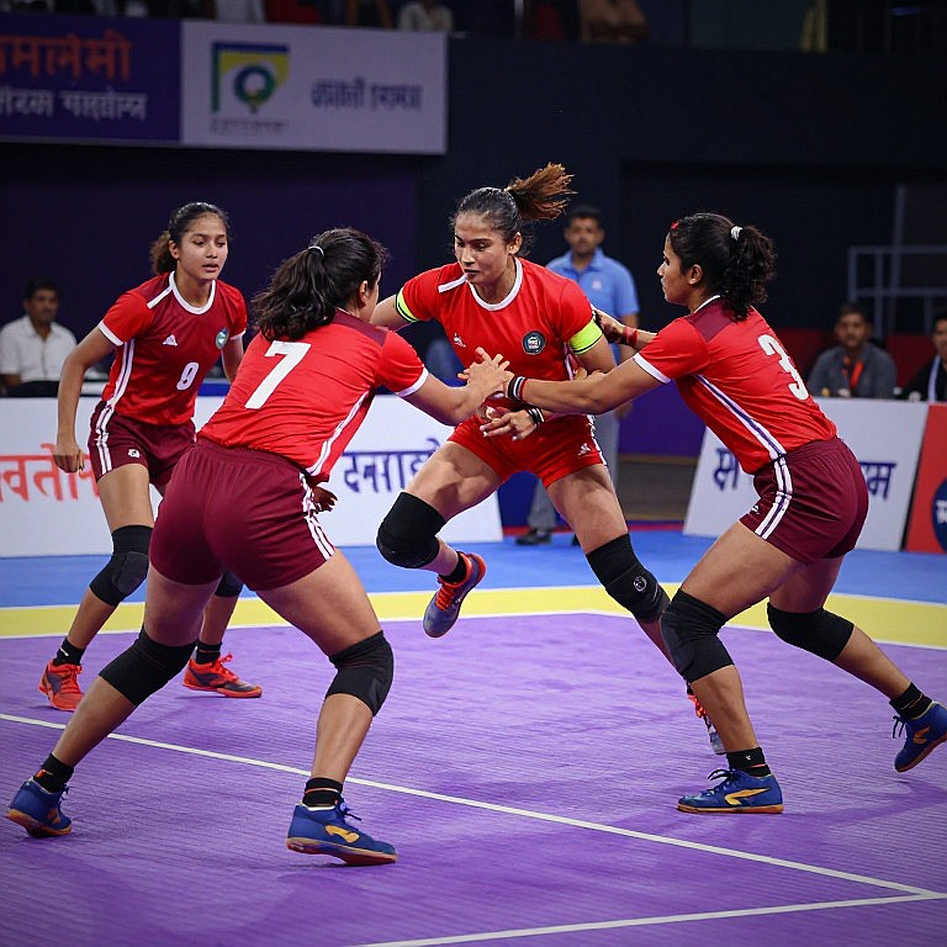
This is where the release's language and the tournament's architecture diverge: 39 and 23 both only add up if neither competition plays a third-place match. With a bronze-medal game, the men's figure would be 40 and the women's 24. The direct consequence is that a semifinal loser on 30 October is done — no ranking game, no consolation, no third place. That is the harshest rule in the format, and it is never the first line of a press note. I am treating this as a deduction from published numbers; AKFI's draw document is the final authority, and if a bronze match is listed there, the group-game count changes, not the total.
— Context: what campus this tournament stands on
The organiser is the Amateur Kabaddi Federation of India, with approval from the International Kabaddi Federation. It will be played inside the standard-style jurisdiction, on the mat, under the IKF rule book. England, meanwhile, hosted the circle-style World Cup earlier this year — a different organising authority, a tradition rooted in Punjab's festival circuit. Two codes, two jurisdictions, and the dispute is present from day one because India's first men's opponent is England.
The calendar holds nine days, 23 to 31 October. Semifinals on 30 October, both finals on 31 October. India's men play six group matches: England on 23, Uganda on 24, Malaysia on 25, Nigeria on 26, Tanzania on 27, rest on 28, Sri Lanka on 29. The women play four: Malaysia on 23, Singapore on 24, Uganda on 25, Nigeria on 26 — then wait until the 30 October semifinal.
Surjeet Singh captains the men, Naveen Kumar is vice-captain. The 14-member squad also includes Sachin Tanwar, Pankaj Mohite, Bharat Hooda, Shubham Shinde and Parvesh Bhainswal. Nidhi Sharma leads the women, with Ritu as vice-captain; Muskan Sharma, Riya Kumari, Simran Kamboj and Karthika Ramesh are in the squad.
Ahmedabad is preparing to host the 2030 Commonwealth Games, and this championship is part of that pitch. A pitch and a receipt are different documents. The pitch is that India is kabaddi's global centre. The receipt is whatever is written on the match sheet on 31 October.
— The five-day staircase: the calendar is India's real opponent
India's first genuine opponent is not England. It is the schedule. Five straight days from 23 to 27 October, five matches. Then one rest day, then Sri Lanka on 29, a semifinal on 30, a final on 31. If India reach the final, that is eight matches in nine days — six group games inside seven days.
That shape is a consequence of a seven-team group. Group B, with six teams, gives each side five matches; Group A gives six. Fitting both into a nine-day window left one route: compress India's block. Hence the rest day on 28 October falls after five matches rather than in the middle.
In management terms this is not a rotation tournament for India; it is a load audit. Across five consecutive days a raider's recovery cycle breaks and the cover's chain-tackle reaction slows. Uganda (24 October) and Tanzania (27 October) are the fixtures on this staircase where the fourth and fifth raiders must get mat time, or else the same starting seven who begin on 23 October will be the same tired seven facing Sri Lanka on 29 October.
Naveen Kumar's vice-captaincy belongs inside that arithmetic. There is exactly one reliable source on fitness: the warm-up sheet and the minutes spent on the mat. The "week-to-week" language that comes out of franchise media handles has proved one thing across recent seasons — an injury is not healed until it is healed, and everything in between is PR. Ever since a junior NBA columnist was pulled onto the PKL beat in Ahmedabad in 2026, I have kept one habit: score sheet first, team news second.
— England: a boundary dispute on day one
The 8:30 PM fixture looks easy on paper and is not easy in the arena. England's kabaddi base comes out of the circle-style circuit — the tradition whose most recent public document is the 2026 England World Cup. In circle style the mat's geography, the position of the lobby and the distance of the tackle are different. When the same player steps onto a standard mat under IKF rules, his habits show in the first two or three raids, especially a late entry into the lobby and a tackler who leans into the cover's line.
For India this match is procedural rather than technical. Day one is for deciding the order in which the defensive chain forms: how late Parvesh Bhainswal and Shubham Shinde react in cover, and whether the outer cover is already set up for a double tackle in the first raid. One pattern has been on the record from the 2026 Ahmedabad final to now: when the Indian defence fails to produce tackle points in the first two raids, the raider drifts toward do-or-die from the third, and the scoring rate flattens.
— The women's column: 23 matches, four group games, one absent league
The women's field has ten teams in two groups of five, four group matches each, and only the top two reach the semifinals. India's Group A holds Singapore, Nigeria, Uganda and Malaysia; Group B holds Bangladesh, Kenya, England, Scotland and Sri Lanka.
In a four-match group, a single defeat can end the campaign, because the tie-break runs to score difference — and the only way to build a difference across four games is to stop playing empty raids in the 40th minute against weaker sides. This is where young teams leak: a six-point win and a sixteen-point win are not one place apart in the table, they are two.
The most important fact about Nidhi Sharma's captaincy and Ritu's vice-captaincy is not on the team sheet but on the calendar. India's four women's matches run on consecutive days, 23 to 26 October, followed by a three-day gap to the 30 October semifinal. Rhythm, once built, must be kept fresh for three days — exactly the opposite of the men's problem, where rhythm may never get a chance to form.
The most revealing number in this championship is 39 against 23. Thirteen men's nations against ten women's; 36 men's group matches against 20. That gap is not an organising error; it is the truth of the pool. There is still no franchise league for women domestically, so the national-team pool comes from the same academies and state units that do not receive investment comparable to the men's circuit. Until that column fills, 23 stays where it is.
— The part the release did not say: a map of 13 nations
Sort the list by continent. Africa sends four — Kenya, Nigeria, Uganda, Tanzania. Europe sends two — England, Scotland. Oceania sends one — Australia. The Americas send one — Canada. Asia sends five — India, Bangladesh, Sri Lanka, Malaysia, Singapore. Add them: 13.
That map is not the Commonwealth's map. No Caribbean nation, no South Africa, no New Zealand, no Pakistan. Five continents are represented, but four of the countries come from a single African pool and the Americas are represented by one nation. A 62-match structure is not a certificate of global depth; it is the most reliable list of 23 teams available to the host federation.
— The silence around score difference
In a seven-team group, one defeat does not end a campaign — that is the men's biggest relief. The reverse is equally true: across six matches, three teams can land on 4-2 or 5-1, and then score difference decides. For India that means the four fixtures between 24 and 27 October — Uganda, Malaysia, Nigeria, Tanzania — are not only for winning but for margin.
One line has repeated on this beat: the box score records the event; the notebook records the decision. An empty raid in the 40th minute reads as a zero in the box score. In the notebook it is a deliberately taken risk that returns as a point in tomorrow's tie-break.
— The Jakarta file, and the habit of "gold guaranteed"
In 2026 in Jakarta, India's men lost the semifinal 18-27 to Iran and a group game 23-24 to South Korea; the women lost the final 27-24 to Iran as well. I was covering remotely from the Ahmedabad desk and had to do the hardest thing in crisis copy — rewatch both matches and count tackle points and do-or-die choices. The finding was that the loss was selection, not sentiment: against a raiding line-up picked on reputation, Iran set a wrestling-based defence and pushed India into low-percentage raids.
One rule from that file still applies: before calling any Indian kabaddi team a guaranteed gold, the scoreline must be quoted with its date attached. Iran are not in this field, so the risk is different — the risk is not the opponent but the unfamiliar mat. Malaysia, Kenya and Uganda have thin public mat records, which means the Indian team will not have reliable tape of their defence. Against an unfamiliar defence a raider does what habit dictates in the first two raids; if that fails three times, the entire plan changes.
When the stadiums went empty in 2026, I rewatched Bengal Warriors' 39-34 win over Dabang Delhi in the Season 7 final and built a defender-stability sheet from the 2026 Asian Games data. One thing became clear: an empty stadium does not remove pressure, it relocates it — from the crowd to the rule book, from the noise to the whistle. The 11:00 AM Kenya-Singapore match in Ahmedabad will not be full. It is the tournament's real thermometer, because nobody there is playing for a medal, only for process — and when the crowd disappears, the sound of bad process gets louder.
— What changes after day one
On 24 October the women face Singapore and the men face Uganda. If both captains play their full starting seven for forty minutes on day one, the fatigue of 27 October will be the mistake of 23 October. The rotation call does not come from data; it comes from the calendar, and the calendar says six matches in seven days.
The Sri Lanka fixture on 29 October may be Group A's heaviest game, because it is the first match after the rest day and the semifinal follows the next day. On 30 October the semifinal loser has no third-place match — that is what 39 and 23 are saying.
By the evening of 31 October, when both finals are done, Ahmedabad will have proved something for 2030. Medals are not evidence of depth. The real question is whether a semifinal can be played without India in it — and whether the women's column ever climbs above 23. When the match sheet closes on 1 November, look at whether people remember the two final scores, or the one line that was never in a press release: 39 against 23.