
India vs Uganda: The 26 Inside 46-26, and the 'Asian Games 2026' Error
**मुख्य उत्तर:** कॉमनवेल्थ कबड्डी चैंपियनशिप 2026 के मैच 9 में भारत का सामना युगांडा से है और भारत भारी पसंदीदा है। लेकिन इंग्लैंड के खिलाफ 46-26 की जीत में 26 अंक लुटाना डिफेंस की चिंता दिखाता है, जबकि ईरान, बांग्लादेश और दक्षिण कोरिया की गैरमौजूदगी इस दबदबे को अधूरा साबित करती है। **मुख्य तथ्य:** - भारत ने इंग्लैंड को 46-26 से हराया; युगांडा ने मलेशिया को 45-29 से हराया (मैच 9, दिन 2)। - कबड्डी कभी कॉमनवेल्थ गेम्स का मेडल इवेंट नहीं रहा; यह स्वतंत्र इनविटेशनल टूर्नामेंट है। - ईरान, बांग्लादेश, दक्षिण कोरिया और पाकिस्तान इस चार-देशीय फील्ड में शामिल नहीं हैं। - स्रोत में 'एशियाई खेल 2026 स्वर्ण पदक विजेता' दावा संदिग्ध है; भारत का ताजा स्वर्ण हांगझोउ 2022 (अक्टूबर 2023) का है। - भारत ने 'फ्रेश स्क्वाड' उतारा है, यानी रोटेशन — 46-26 ताकत का पैमाना नहीं है। **स्रोत:** Khel Now, कॉमनवेल्थ कबड्डी चैंपियनशिप 2026 — भारत बनाम युगांडा मैच 9 प्रीव्यू। प्रकाशन तिथि स्रोत लेख में अंकित नहीं है। **संबंधित प्रश्न-उत्तर:** प्रश्न: क्या भारत युगांडा से हार सकता है? उत्तर: सिद्धांततः नहीं — भारत वैश्विक स्तर पर शीर्ष-2 टीम है और युगांडा विकासशील है, पर 22 या अधिक अंक लुटाना आगे के लिए चिंता का संकेत होगा। प्रश्न: क्या कॉमनवेल्थ कबड्डी चैंपियनशिप आधिकारिक कॉमनवेल्थ गेम्स प्रतियोगिता है? उत्तर: नहीं — कबड्डी कभी कॉमनवेल्थ गेम्स का मेडल इवेंट नहीं रहा, यह 'कॉमनवेल्थ' नाम उधार लेने वाली स्वतंत्र प्रतियोगिता है। प्रश्न: भारत का सबसे ताजा एशियाई खेल पुरुष कबड्डी स्वर्ण कब आया? उत्तर: हांगझोउ 2022 एशियाई खेलों में, जो अक्टूबर 2023 में खेले गए — फाइनल में भारत ने ईरान को 33-29 से हराया था।
46-26. I saw the score, took a screenshot, and then got stuck on the number nobody was reading — 26.
India beat England by twenty points. The headline is that twenty. My job is the twenty-six, because how does a side that calls itself the world's number two concede twenty-six points to a team like England? That question should have been asked before Match 9, where India face Uganda — and where nobody bothered to notice that Uganda beat Malaysia 45-29 in their opener.
It was eleven at night when I opened that scoreboard. The phone was borrowed; the haircut was mine; the rumour did the rest. The habit goes back to 2026, when I stacked fourteen of Pardeep Narwal's dubki escapes on a cousin's Redmi and ran a counter in the corner of the screen. Even then I grabbed one number and dropped everything else. I am still doing the same thing.
The 'Commonwealth' name, and what sits behind it
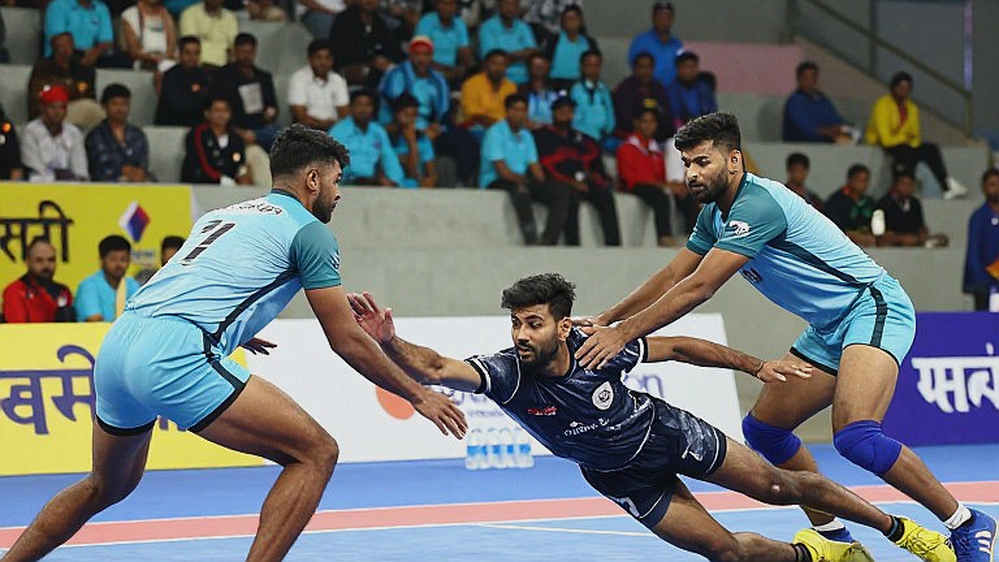
The event is called the Commonwealth Kabaddi Championship 2026. Four names in the field — India, England, Uganda, Malaysia. India beat England 46-26, Uganda beat Malaysia 45-29. India have fielded a fresh squad. Match 9, Day 2.
One thing needs saying plainly: kabaddi has never been a Commonwealth Games medal event. No edition of the Commonwealth Games has included kabaddi. This tournament is not part of that official framework — it is a separate invitational competition borrowing the word 'Commonwealth' to add prestige. That sounds like a small thing. It isn't. When you attach a big brand to an event, the viewer's expectation climbs to that level. Then a 46-26 scoreline arrives and nobody can tell whether it means strength or weakness.
Now to the score itself. Forty-six and forty-five in a forty-minute format are very high totals. In the modern game, that kind of number is built by one mechanism: the All Out. When all seven players of a side are out at once, the opponent gets two bonus points and the full seven return. If the losing side has conceded two or three All Outs, the scoreboard balloons. Which means 46-26 and 45-29 are saying the same thing — the beaten team's defence fell apart and the contest never existed. This is not the kabaddi Iran and India play, where both sides defend under twenty and every raid becomes do-or-die.
For India, the worrying number is 26, not 46
When India play a developing side, their defence normally stays under twenty. Here England took twenty-six. I know the counter-argument coming — 'they still won by twenty'. They did. That doesn't close the question.
For comparison, one checkable fact: in the Hangzhou 2026 Asian Games men's kabaddi final, played in October 2026, India beat Iran 33-29. India conceded twenty-nine that day. But that was Iran — a side built on wrestling-derived thigh holds, whose Fazel Atrachali became the Pro Kabaddi League's all-time leading tackle-points scorer. Conceding twenty-six to England does not belong in that category. Twenty-nine against the world's hardest defence and twenty-six against a diaspora-based developing team look like the same number. They are not.
And this is where the real problem starts. The three nations that genuinely threaten India — Iran, Bangladesh, South Korea — are not in this field. Neither is Pakistan. When your strongest rival is not on the mat, dominance cannot be demonstrated by anything. A 46-26 could have arrived with India playing at half intensity. That is why my standing rule holds: since Jakarta 2026, every preview should name Iran as co-favourite, never spoiler. Jakarta also taught me that a thread can find you before you find yourself — and that lesson still applies, because calling an Iran-less win 'dominance' is exactly the old habit that produced the 2026 bronze.
Uganda: the most honest story in this tournament
If there is one thing here I will take seriously, it is not India's 46 but Uganda's 45. Beating Malaysia 45-29 says Uganda have a functioning raiding unit, not just a defence. Uganda and Kenya are Africa's most active kabaddi nations, and this presence is the product of decades of development work, not a charity exhibition.
But honesty is needed here, or we will slide into the 'kabaddi is going global' speech. The non-Indian half of this field is mostly diaspora, not organically adopted. Malaysian kabaddi is tied to the country's large Tamil-origin community; English kabaddi runs on the British-Asian community. These teams are real, their standing is real, but their footprint is narrow. Uganda is the exception, which is exactly why it is the most interesting name on the list.
There is no salary ladder at this tier — and that is the biggest story
Here is the part nobody writes. There is no auction at this tournament, no graded contract, no salary ladder. In the Pro Kabaddi League, Pardeep Narwal went to UP Yoddhas for ₹1.65 crore in the 2026 auction. A player from the same sport is competing here with no financial structure around him, and nobody is asking about it. Six hundred raids taught me more about football transfers than any fax machine. This is the labour story we keep forgetting — a railway clerk or a police constable can become a crore-rupee lot, but only when a league picks him up. Where there is no league, the same player competes internationally with no safety net at all.
Which is also why I refuse to read 'fresh squad' as proof of strength. Rotation means the coach himself is treating this as a test rather than a result. If India are calling it a test, on what authority do I call 46-26 evidence?
And then the line that stung
The source report describes the Indian team as the 'Asian Games 2026 gold medallists'. That line is wrong. The 2026 Asian Games in Aichi-Nagoya are scheduled for September–October 2026, which means they had not been played at the time of this match. India's most recent men's kabaddi gold came at Hangzhou 2026, held in October 2026. When a news report writes 'Asian Games 2026 gold', it is not describing a player's achievement — it is describing its own proofreading. I keep a private error log, dated and graded. This line goes in it.

Where I could be wrong
First possibility: those twenty-six points came from garbage-time All Outs. If India had already reached 46-16 and the defenders loosened in the last three minutes, the twenty-six means nothing. A scoreline shows the outcome, not the minute-by-minute truth.
Second, and more serious: I do not have raid-by-raid data from this match. My 600 do-or-die raids sheet covers PKL Seasons 5, 6 and 7 — not this tier. A spreadsheet can hold six hundred do-or-die raids and still miss the point if you charted the wrong tournament. What I am doing here is inference from a final score. Inference should be labelled as inference, and that is what I am doing.
Third: my irritation at the 'Commonwealth' label may be oversized. If a recognised body — the IKF or a regional federation — stands behind the organiser, the naming complaint shrinks and the only question left is who that body is. This report names nobody, and that absence is the whole basis of my complaint.
Fourth: the writer who typed 'Asian Games 2026' may have meant that India are travelling as defending champions. The intent may be clean. The sentence is still wrong, and intent does not change a fact.
What to watch next
If India concede twenty-two or more against Uganda, that is not a one-match slip — it is a trend, and it should be tracked before the Asian Games. If India hold Uganda under twenty, I withdraw the twenty-six worry and file it as an England-match, garbage-time event. Either way, I keep the number.
And one question I want answered by the organisers: who is sanctioning this championship? Until I get that answer, I will keep calling it the 'Commonwealth' Kabaddi Championship — with the quotation marks attached. I have the sheet. What do you have?