
Santner's Signal: No Short-Ball Plan for Rohit, Pressure on Kohli — India's Top Order Faces the Christchurch Test
क्राइस्टचर्च के हैग्ली ओवल में भारत-न्यूजीलैंड एकदिवसीय सीरीज़ के पहले मुकाबले से पहले कप्तान मिशेल संतनर ने कहा कि भारत का टॉप ऑर्डर तेज़ खेलता है, विराट कोहली बीच के ओवरों में एंकर की भूमिका निभाते हैं और आखिर में पावर हिटिंग आती है; न्यूजीलैंड की योजना नई गेंद से जल्दी विकेट लेकर दबाव बनाने की है। संतनर ने स्वीकार किया कि रोहित शर्मा अब शॉर्ट गेंद को छक्के के लिए मारते हैं, यानी पुराना शॉर्ट-बॉल प्लान कारगर नहीं। उपलब्ध आँकड़ों में रोहित ने वेस्टइंडीज़ के खिलाफ तीन पारियों में 225 रन 75 की औसत और 115 से ऊपर के स्ट्राइक रेट से बनाए, जबकि कोहली ने 168 रन बनाए और 296 के लक्ष्य का पीछा करते हुए 88 गेंदों में 139 नाबाद रहे। ध्यान दें: सभी सूचना बिंदुओं पर स्रोत उपलब्ध नहीं है, तीन पारी का नमूना प्रवृत्ति सिद्ध नहीं करता, और मूल सामग्री का 2027 विश्व कप 'एक साल से कम दूर' वाला दावा गलत है — वह टूर्नामेंट अक्टूबर-नवंबर 2027 में है। क्राइस्टचर्च में भारतीय दर्शकों का समर्थन न्यूजीलैंड का होम एडवांटेज कम करता है। यह जानकारी केवल खेल-संदर्भ हेतु है, सट्टेबाजी सलाह नहीं।
Before the opening ODI of New Zealand's home series against India at Hagley Oval, Christchurch, captain Mitchell Santner said things that sound like routine pre-match press-conference material. Read carefully, however, they sketch the outline of New Zealand's entire tactical thinking against India's top order. Santner stated plainly that India's top order goes hard from the start, that Virat Kohli anchors through the middle overs, and that power hitting arrives at the end. That is a genuinely useful, non-trivial read of India's batting architecture — and it is the most substantive part of the whole statement.
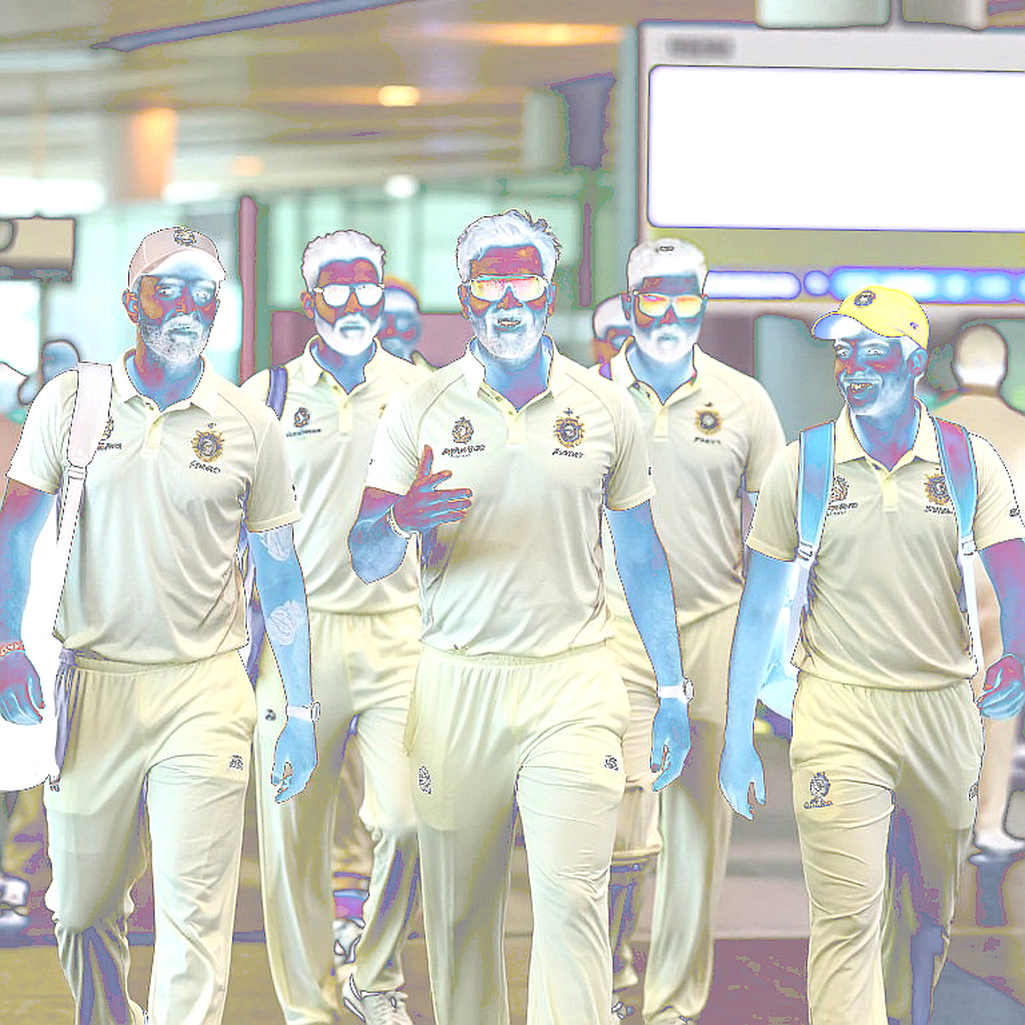
This report examines Santner's comments, the available data on Rohit Sharma and Virat Kohli, Shubman Gill's situation, the inferred conditions at Hagley Oval, the Christchurch crowd dynamic, and the risks attached to India's top-heavy batting structure. It also flags clearly where the available information is insufficient, because honest sports journalism must present what is unknown as inference, not fact.
Santner's three-phase model
Santner divided the Indian innings into three phases. First, an aggressive top order in which the openers take risk. Second, Kohli's anchor role, stabilising the innings and controlling tempo through the middle overs. Third, power hitting in the closing overs. None of this is new, but an opposing captain stating it publicly matters: New Zealand's plan is to break each phase separately — shorten the first by taking early wickets with the new ball, slow the second by applying pressure on Kohli, and deny runs at the death.

'Good balls for a period, build pressure' — the new-ball plan
Santner's most relevant line was that it is 'just good balls for a period of time, build pressure in one-day cricket.' This is the standard ODI template against a top-heavy batting side: take early wickets, force the middle order to rebuild, and delay or prevent the end-overs power phase.
A methodological warning is essential here. Every information point in the underlying material carries no source attribution, and the outlet and author are unspecified. What we have is one captain's pre-match remarks — routine media content with low intrinsic information density. It should be read as strategic signalling, not genuine intent disclosure. Any captain's public statement is partly performative and may be deliberate misdirection.
Rohit Sharma and the short-ball story
One Santner remark deserves particular attention. He conceded that Rohit now hits short balls for six, meaning the old short-ball plan against him no longer works. This can be read two ways. Either it signals a real tactical shift — New Zealand will rely on fuller, swinging deliveries and middle-overs spin control instead of the short-ball default. Or it is a deliberate public concession that flatters the Indian audience while concealing a different plan. The available text cannot resolve which.
Rohit's numbers: small sample, large signal
Across three innings against West Indies, Rohit made 225 runs at an average of 75 and a strike rate above 115, including one century and one fifty. Elite ODI openers typically strike at 90 to 100, and aggressive openers at 105 to 110, so above 115 is clearly above benchmark. This is the single most analytically interesting datapoint, because it directly contradicts the older narrative Santner himself referenced. But discipline is required: three innings is statistically inadequate. It is a hot-streak snapshot, not a trend. Whether Rohit's strike-rate profile has genuinely shifted will only be confirmed with five-plus innings and splits for away conditions, pace and spin. No such splits are provided.
Kohli: an anchor, but a tempo-setting one
Kohli made 168 runs in three innings at an average of 56, with a highest score of 139 not out off 88 balls while chasing 296 — a strike rate of roughly 158 in that innings. That complicates Santner's 'anchor' characterisation. A traditional anchor prioritises occupying the crease over scoring speed; 139 not out off 88 balls suggests Kohli functions as a tempo-setting anchor rather than a sheet anchor. Modern ODI chases require anchors to accelerate, and Kohli has shown he can. Still, this is a three-innings sample against one mid-tier opponent, and treating it as proof of enduring form would be premature.
Shubman Gill: one sentence, no data
Gill is mentioned only in passing as 'outstanding as well'. No figures, no innings detail, no situational split. Any conclusion about him would be unfounded; the honest answer is that the information is insufficient.
Hagley Oval: caution over conditions
The material contains no pitch report and no weather, dew or DLS data. Hagley Oval has a well-established reputation for pace, bounce and seam movement, favouring the new-ball bowler early and tall, seam-up operators, but this is inference, not verified fact for this fixture. Confidence is medium at best, and readers should treat it accordingly.
Christchurch's Indian support: home advantage diluted
The strongest concrete point in the entire analysis is Santner's own acknowledgement that India will have strong support in the stands, and that Rohit and Virat being present draws crowds. This is not mere courtesy. It signals a dilution of home advantage: where a large diaspora is present, the venue becomes effectively neutral or partisan toward the visitor. It also illustrates India's structural commercial gravity as the sport's travelling draw.
Age, experience and the 2027 World Cup timeline
Santner handled the age question diplomatically — they are 'getting on' but 'still playing very well' — which is hedging, not analysis. Rohit is 39 and Kohli 37. A significant factual issue arises here: the source material claimed the 2027 ODI World Cup is 'less than a year away'. That is almost certainly wrong. The 2027 ODI World Cup is scheduled for October–November 2027, roughly two years out. Readers should treat that framing as a red flag on the article's reliability. Equally, the claim that there are 'no signs of slowing' is an assertion, not evidence: no longitudinal trend line is offered, and both players are past the typical 27–33 batting peak. The age-curve factor is real, even if it is not urgent for a bilateral series.
New Zealand's bowling: the biggest information gap
The largest gap in the entire analysis is that New Zealand's bowling composition is unknown. Who opens the bowling, what pace resources exist, and whether spin is used in the powerplay or middle overs are all absent. The only clue is that the captain is a left-arm spinner, suggesting a middle-overs spin reliance. India's middle-order and death-hitting resources are also unnamed, so Santner's 'let the power come in at the end' cannot be evaluated against specific players.
India's top-order dependency and middle-order risk
The public narrative is entirely star-centric. The under-discussed strategic risk is India's middle order: if Rohit and Kohli both fall cheaply, the end-overs power phase may never activate. No Indian middle-order player is named in the material, so this risk cannot be quantified — but it cannot be ignored either. New Zealand's risk is that their stated plan is the plan every side uses against India, with mixed historical success. No head-to-head data is provided.
Sources and reliability: an explicit warning
Every information point carries no source, and the outlet and author are unknown. The most load-bearing content is one captain's pre-match press remarks. Any number used here — 225 runs, 168 runs, 139 not out off 88 balls, a target of 296 — should be verified against official scorecards before being relied upon. This report states that limitation openly. It should also be noted that this is an international bilateral ODI series, not a league fixture: there is no auction, franchise valuation, transfer, contract or governance controversy in scope, and manufacturing such risk would be dishonest.
Risk matrix
Sporting risk to India: a top-order collapse against a seam-friendly new-ball spell — precisely the scenario Santner is targeting. Medium likelihood, high impact. Mitigation is Kohli's anchor role, if he gets set. Sporting risk to New Zealand: the short-ball plan backfires, as Santner himself conceded Rohit now hits those deliveries for six. The highest risk of all is analytical rather than sporting: over-reading a three-innings sample as a trend and accepting the factually flawed World Cup timeline as settled fact. Personnel risk: an ageing core, real over a multi-year horizon though not urgent for one bilateral series. Weather: rain and DLS at Christchurch remain a theoretical risk, with no data available to assess it. Overall risk rating is low to medium — a routine pre-match piece with no hard risk event.
Signals to track
Rohit's strike rate in the first-match powerplay; if above 120, it confirms a genuine profile shift rather than a West Indies-specific burst. Kohli's tempo between overs 11 and 40 and his acceleration after over 30. New Zealand's new-ball effectiveness; two or more wickets in the first ten overs activates Santner's plan. Any published pitch report or weather forecast for Hagley Oval. India's scores at positions four to seven, which will reveal top-order dependency. And the source's credibility, which should be downgraded further if the World Cup timeline is confirmed as erroneous.
Terminology
ODI: One Day International, 50 overs per side — the format context throughout. Anchor: a batter who prioritises occupying the crease over raw scoring speed. Strike rate: runs per 100 balls faced. Powerplay: the first ten overs, when only two fielders are permitted outside the 30-yard circle. New-ball spell: the opening overs with the harder ball, when seam and swing are most available. DLS: the Duckworth-Lewis-Stern method for revising targets after rain. FTP: the ICC's Future Tours Programme of bilateral fixtures. Diaspora crowd effect: large overseas supporter populations turning an away fixture into a de facto neutral or pro-visitor venue.
Conclusion
This is a routine, low-information-density pre-match piece whose substance reduces to three things: one captain's diplomatic acknowledgement of two elite Indian batsmen; a genuine tactical split, Rohit as aggressor and Kohli as anchor; and a small, single-opponent form sample that the article overstates as proof of enduring form. Its primary analytical value is tactical signalling, not hard data. Its primary reliability flaw is the erroneous World Cup timeline plus the complete absence of source attribution and venue detail. Readers should take Santner's remarks as directional signals rather than settled plans, treat three innings as a snapshot rather than a trend, and verify every number against official scorecards before the first ball is bowled. This is provided for sports-information reference only and does not constitute betting advice.