
Virat Kohli Makes ODI History in Auckland with 13,000 Runs at No. 3
कोर उत्तर: विराट कोहली ने ऑकलैंड में वनडे क्रिकेट में नंबर-3 पर 13,000 रन पूरे किए और इस बल्लेबाजी स्थान पर यह उपलब्धि हासिल करने वाले पहले बल्लेबाज बने। उनका नंबर-3 वनडे औसत 61.61 है। मुख्य तथ्य: - उपलब्धि केवल वनडे क्रिकेट और नंबर-3 बल्लेबाजी स्थान से संबंधित है। - विराट कोहली ने नंबर-3 पर 13,000 रन पूरे किए। - रिकी पोंटिंग 12,662 रन के साथ दूसरे स्थान पर हैं। - विराट कोहली का औसत 61.61, रिकी पोंटिंग का 42.48 है। - न्यूजीलैंड 40.2 ओवर में 185 रन पर ऑल आउट हुआ। स्रोत: Times of India, प्रकाशन तिथि उपलब्ध नहीं; मैच और रिकॉर्ड संबंधी सार्वजनिक जानकारी। संबंधित प्रश्न: प्रश्न: क्या विराट कोहली का रिकॉर्ड सभी बल्लेबाजी स्थानों के लिए है? उत्तर: नहीं, रिकॉर्ड वनडे में नंबर-3 पर बनाए गए 13,000 रनों तक सीमित है। प्रश्न: इस मैच में विराट कोहली ने कितने रन बनाए? उत्तर: उपलब्ध रिपोर्ट में विराट कोहली का व्यक्तिगत स्कोर दर्ज नहीं है, इसलिए इसकी पुष्टि आधिकारिक स्कोरकार्ड से करनी होगी। प्रश्न: न्यूजीलैंड के खिलाफ भारत की गेंदबाजी में किसने अच्छा प्रदर्शन किया? उत्तर: अर्शदीप सिंह ने चार, गुरनूर बराड़ ने तीन और अंशुल कंबोज ने दो विकेट लिए।
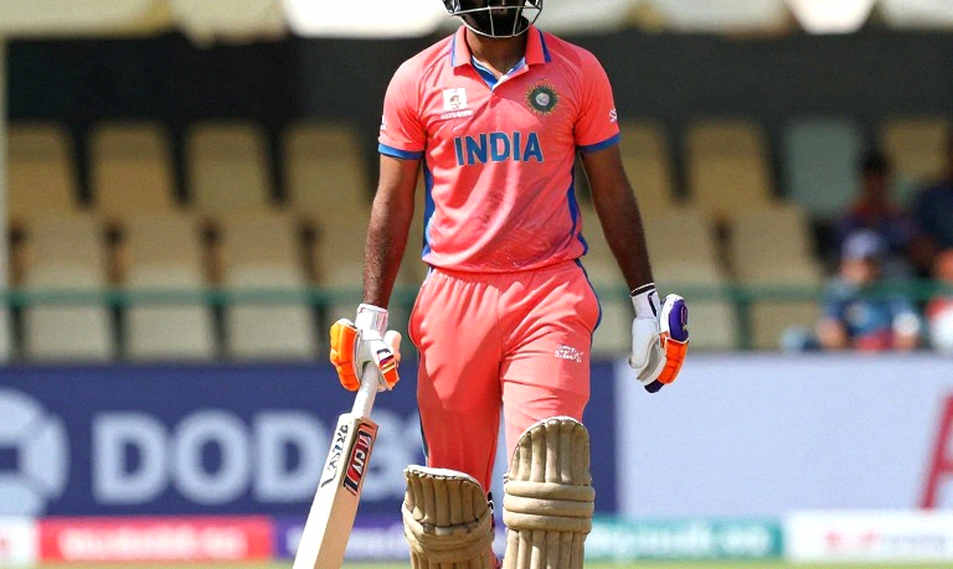
At Eden Park in Auckland, the most significant fact from the first ODI between India and New Zealand was not New Zealand’s total of 185. It was the batting position from which Virat Kohli has built one of ODI cricket’s most substantial records. Kohli completed 13,000 ODI runs at No. 3, becoming the first batter to reach that mark at the position.

The record should not be confused with his individual score in the match. The available report does not state Kohli’s score in the innings. It is therefore premature to describe the achievement as a match-winning performance or proof of current form. This is a career aggregate restricted to ODI cricket and to one batting position.
Context: the scope of the record
According to the Times of India report, the milestone came in the opening match of India’s five-match ODI series in New Zealand. India won the toss and bowled first, dismissing New Zealand for 185 in 40.2 overs. Given Eden Park’s short boundaries and generally batting-friendly reputation, the total indicates a New Zealand innings that came under sustained pressure. The available information does not state the pitch condition, weather, or whether the Duckworth-Lewis-Stern method was involved.
India’s pace attack accounted for nine of New Zealand’s ten wickets through Arshdeep Singh, Gurnoor Brar and Anshul Kamboj. Arshdeep took four wickets, Brar three and Kamboj two. That points to a pace-led plan on the day, although one match cannot establish India’s long-term bowling hierarchy. The selection of Brar and Kamboj alongside Arshdeep also suggests that India were examining their seam depth during the series opener.
The available material does not include India’s complete reply or the final result. New Zealand’s 185 therefore cannot be placed within a full result-and-process assessment. The record is clear; the match context remains incomplete.
The average matters more than the tally
The most important figure behind the milestone is not 13,000 but Kohli’s average of 61.61 at No. 3. Ricky Ponting made 12,662 runs at the position with an average of 42.48. Kumar Sangakkara’s listed average is 44.71, Joe Root’s 53.12 and Babar Azam’s 55.54.
The run gap between Kohli and Ponting is 338, which is substantial but not overwhelming in a long career. The difference in average, approximately 19 runs per dismissal, is more revealing. Kohli combined longevity with efficiency in a role that requires the batter to respond to several different match situations.
The most useful conclusion from this record is the 61.61 average, rather than the 13,000-run total alone. At No. 3, a batter may arrive against a relatively new ball after an early wicket or inherit a stable platform and be asked to control the middle overs. Kohli’s record indicates sustained productivity across both conditions.
After years of reading scorecards, I have found that a batting record must be judged within its role before it is compared across a leaderboard. Runs at No. 3 do not arrive under the same conditions as opening runs. The position carries responsibility for recovery, acceleration and innings control. Kohli’s average is evidence of long-term success under that responsibility.
Four ledgers, one record and three meanings
A major statistic requires four separate entries: format, batting position, career period and match context. Here, the format is ODI cricket, the position is No. 3, the period is Kohli’s ODI career, and the match is one fixture in Auckland. The record becomes accurate only when these categories remain separate.
The phrase “first batter in history” is attractive in a headline, but the precise description is “the first batter to score 13,000 ODI runs at No. 3.” This is not an all-format record or an all-position ODI record. Sachin Tendulkar scored 13,685 ODI runs at No. 2. The correct way to present Kohli’s achievement is to preserve its exact scope.
That distinction matters because total ODI runs, runs at No. 3 and runs across all formats belong to different statistical ledgers. A correct figure can still create a misleading impression when it is introduced with the wrong category. I learned this during the statistical disputes that followed the 2026 match-fixing inquiry: the number may survive scrutiny while the framing does not.
Return, selection and the team’s next test
The report also refers to the return of Kohli, Rohit Sharma and KL Rahul to India’s ODI XI. That indicates the return of experience to India’s top order. The available information does not provide recent innings data, home-away splits or a last-12-month trend. No sound judgment about Kohli’s current form, age curve or decline can be drawn from this report.
India’s pace performance is a useful signal. Arshdeep, Brar and Kamboj dismissed New Zealand inside 41 overs. The available data cannot establish whether seam movement, bounce, wind or New Zealand’s shot selection caused the collapse. I learned to read silence in a ledger as data, not as an invitation to fill the gap with assumption. Pitch and weather information are absent here and should remain recorded as absent.
The use of developing fast bowlers across a five-match series may represent workload management, selection testing or both. Over distribution, fitness updates and repeated combinations across the next matches will provide stronger evidence. At present, it is a selection signal from one game.
Contrarian angle: a record is not a match innings
Kohli’s 13,000-run achievement is durable and significant. Yet reaching a career milestone during a match does not automatically make the innings itself exceptional. Kohli’s score in Auckland is not given. If the milestone arrived during a short innings, the record would retain its value while the match-performance interpretation would change.
That distinction is often lost in the fast news cycle. A career aggregate does not establish current form. Four wickets in one match do not prove a series-long bowling advantage. New Zealand’s 185 does not settle the question of India’s overall team strength. The toss, venue, conditions and innings must be logged separately.
Kohli’s name also carries substantial media value in India. A “first batter” headline naturally attracts attention. In this instance, the underlying statistic is strong because the 61.61 average supports the celebration. The credibility risk lies in compressing a position-specific record into an absolute claim.
What to track next
Kohli’s No. 3 record is structurally secure for the immediate future. Babar Azam is listed with 6,054 runs in the comparison, leaving a gap of roughly 7,000 runs. The next matches in the series will answer more useful questions: what will Kohli’s innings scores look like, how heavily will India use the developing seamers, and can New Zealand respond after being dismissed for 185?
The record has been entered into the ledger. The next entries will show whether it remains a historical statistic or becomes part of India’s current ODI plan.