
Thuy Linh's Ninth National Title: The Domestic Throne Holds, But the Succession Gap Deepens
मुख्य तथ्य: गुयेन थुई लिन्ह (जन्म 20 नवंबर 1997, आयु 28) ने 20-25 अक्टूबर 2026 को क्वांग त्री में आयोजित वियतनाम राष्ट्रीय शीर्ष खिलाड़ी बैडमिंटन चैंपियनशिप के महिला सिंगल्स फाइनल में वू थी चांग को हराकर लगातार नौवां राष्ट्रीय खिताब (2018-2026) जीता। रिपोर्ट किए गए सेट स्कोर 21-11 और 21-8 हैं, जो सीधे सेटों में जीत (2-0) दर्शाते हैं; स्रोत में इसे 2-1 का कमबैक बताया गया है, जो आंतरिक विरोधाभास है और सत्यापन योग्य है। थुई लिन्ह की विश्व रैंकिंग 28 है और प्रतिद्वंद्वी को रैंकिंग में 57 स्थान नीचे बताया गया है (अनुमानतः लगभग 85वां)। यह प्रतियोगिता BWF वर्ल्ड टूर का हिस्सा नहीं है और विश्व रैंकिंग अंक नहीं देती, इसलिए इसके परिणाम से वैश्विक फॉर्म का अनुमान नहीं लगाया जा सकता। टूर्नामेंट में 14 प्रांतों/शहरों से लगभग 150 खिलाड़ियों ने पांच स्पर्धाओं में भाग लिया। 2025 और 2026 में एक ही दो खिलाड़ियों का फाइनल खेलना वियतनामी महिला सिंगल्स के उत्तराधिकार पूल में खाई का सबसे महत्वपूर्ण संकेत है — यह खिलाड़ी-स्तर नहीं, श्रेणी-स्तर का जोखिम है। थुई लिन्ह वियतनाम ओपन की तीन बार चैम्पियन और टोक्यो 2020 तथा पेरिस 2024 ओलंपियन हैं। मैच में उनका खेल ढंग मूवमेंट अट्रिशन (विविध शॉट से प्रतिद्वंद्वी को दौड़ाकर थकाना) बताया गया है, पर स्मैश गति, रैली लंबाई या त्रुटि दर जैसे कोई तकनीकी आंकड़े उपलब्ध नहीं हैं। निगरानी योग्य संकेत: 2027 के फाइनल में नया नाम, 23 वर्ष से कम आयु की खिलाड़ी का शीर्ष-200 में प्रवेश, और थुई लिन्ह की रैंकिंग का शीर्ष-16 की ओर बढ़ना या 35 से नीचे खिसकना।
Thuy Linh's Ninth Title, But the Questions Are Bigger Than the Trophy
At the Vietnam National Top-Players Badminton Championship held in Quang Tri from 20 to 25 October 2026, Nguyen Thuy Linh defeated Vu Thi Trang in the women's singles final to claim her ninth consecutive national title. The win extends a domestic reign that began in 2026 and once again confirms that, for now, she has no equal in Vietnamese women's singles. But the real significance of this story lies not in the number of titles, but in the signal emerging from the composition of the final: for the second straight year the same two players contested it, and both are in the closing phase of their careers.
This report is based on a domestic, national-level event, not a BWF World Tour or major international tournament. It should therefore not be read as evidence of world-level form. The analysis below is split into three levels: first, the technical and score-level detail of this match; second, the systemic position of the tournament and the structure of Vietnamese women's singles; and third, the risks that structure generates. In between, the source material contains several internal contradictions that should not be hidden — and those are the right place to begin.
The Score Contradiction: A 2-1 Comeback or a Straight-Games Win?
The clearest inconsistency in the available account is that the final is described in one place as a 2-1 comeback, while the set scores recorded are 21-11 and 21-8. The arithmetic is simple: 21-11 and 21-8 means a straight-games win, i.e. 2-0. If the match really was a 2-1 comeback, a third set must have existed and the middle set must have gone to the opponent — but no such score is reported.
The analytical position here is that one of the two is wrong, and the detailed set scores should be treated as more reliable, since detailed scores usually come directly from a scoresheet while comeback descriptions are often produced during summary writing. But it should be clear to the reader that trusting either claim without verification is risky. If this match's data are cited anywhere in future, the original scoresheet should be checked first.
This discrepancy may look like minor editorial carelessness, but it affects the analysis. If the match was won in straight games, it was a one-sided performance with near-zero competitive tension. If it was a 2-1 comeback, it contains a story of being under pressure in one set and then recovering — which says something about the player's mental resilience. The two readings are fundamentally different, which makes the contradiction analytical, not merely technical.
A second, smaller inconsistency concerns age. Thuy Linh was born on 20 November 2026, making her 28 in October 2026, yet one account calls her 29. This does not change the performance conclusions, but it shows the source text was not fully fact-checked. Similarly, the opponent is described as 57 places below in the rankings, which implies Vu Thi Trang is around 85th. That inference is consistent, but given the veteran's standing it deserves independent verification.
The Shape of the Final: 6-6 in Set One, Then a Decisive Gear Change
The most useful piece of match data available concerns the early part of the first set. According to the report, the first set was level at 6-6, after which Thuy Linh changed rhythm and moved to 11-6, eventually taking the set 21-11. The second set finished 21-8.
Two things stand out. First, the level phase up to 6-6 suggests a short probing period — both players feeling out the other's rhythm — after which Thuy Linh raised her pace. That is a mature competitive habit: take no early risks, then shift gear at a set point. Second, this is a single match sample. It cannot establish whether this is a stable strategic pattern or a one-off.
The 21-8 margin in the second set is the most informative element, and what it indicates is a physical fatigue differential. A 28-year-old faced a 34-year-old opponent, and the source description explicitly attributes the second-set gap to the age and fitness difference. That is reasonable, but it is also worth noting that this was a conclusion predictable before the match from the matchup itself.
Thuy Linh: Peak Phase at 28, World No. 28
Understanding Thuy Linh's profile is the key to understanding this story. She currently sits at No. 28 in the world rankings. She was born on 20 November 2026, making her 28 at the time of this tournament. Her professional career spans roughly 14 years, meaning she began competing at national level as a teenager.
Her record includes nine consecutive national titles (2026 to 2026), three Vietnam Open crowns, and appearances at two Olympic Games — Tokyo 2026 and Paris 2026. That is a solid career, and 28 is generally considered peak age in badminton.
But this is where a structural tension emerges. Nine years unbeaten domestically and a world ranking of 28th are both true at the same time, and the gap between them is the centre of this story. The national championship is a title that awards no BWF world-ranking points. The Vietnam Open is regarded as a lower-tier World Tour stop. Her achievement structure therefore rests mainly on domestic and low-tier international events, which in itself is not evidence of a top-20 breakthrough.
Put another way: No. 28 is a respectable position, but it looks like a plateau rather than a sharply rising curve. Given a 14-year career and an age of 28, it can be inferred that a major leap in the coming years is limited — an inference held with moderate confidence, not certainty.
Vu Thi Trang: An Experienced Opponent Whose Physical Limits Are Shifting
Vu Thi Trang was not merely the opponent in this final; she was also the opponent in last year's final. In both 2026 and 2026 the same two players reached the last match. That continuity carries two signals, one positive and one negative.
The positive signal is that both players' levels are stable; they are holding their position and consistently reaching the final rounds domestically. The negative signal is that in two years no new name has reached the final. If the same two players contest the final for two straight years, it also means there is no pressure from below.
Vu Thi Trang's ranking is stated to be about 57 places below Thuy Linh, implying roughly 85th. That is relatively low for an experienced player, and age may be part of the reason. Maintaining top-level movement at 34 is difficult, and that was reflected in the 21-8 second set.
It must be said clearly that the competitive value of this match is limited. When one player is 57 ranking places higher and the opponent is six years older, the probability of a win was already very high. Drawing the conclusion that the winner's technical superiority has been proven is methodologically wrong. This is a confirmation, not a test.
Tactical Analysis: Movement Attrition
According to the available account, Thuy Linh's approach was built on constantly moving her opponent. She used varied shots to make Vu Thi Trang cover different parts of the court, reducing her stamina and inducing errors. In badminton terminology this is movement attrition — a control-based tactic in which the win comes not from smashes but from making the opponent cover maximum distance.
This style is effective against any opponent whose speed and recovery capacity are limited. Against a 34-year-old it was close to an ideal strategy. But the style has a limit: against young, fast top-20 players the same tactic inverts, because they neutralise the pressure with pace rather than by running. What works domestically does not automatically transfer to the world level.
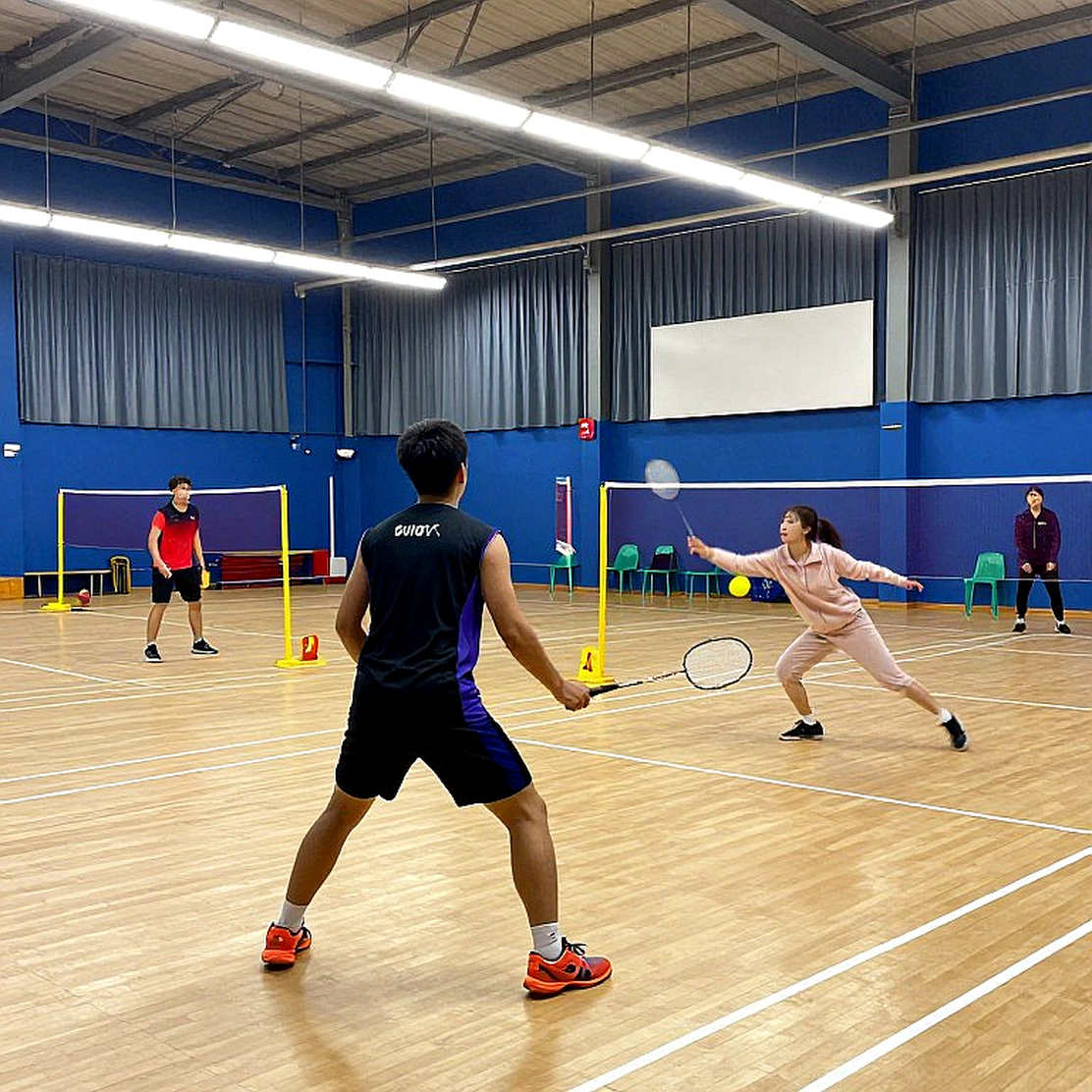
The style carries another implication. The description of varied shots — drops, clears, net play — suggests a control-based identity rather than a smash-heavy attacking one. This is held with moderate confidence, since the source provides no shot-type statistics.
Most importantly, the available material contains no smash speed, rally-length, error-rate or net-point data. That means any claim of technical superiority rests solely on the outcome, and the outcome came against a weaker opponent. Such a claim cannot be called data-supported.
The level phase to 6-6 and the subsequent jump to 11-6 is the single genuinely informative point, in that it shows the player has a second gear she can engage when required. One match does not prove this is a stable trait, but it is a signal worth watching in future matches.
The Tournament's Systemic Position: A Domestic Title, No World Points
This is Vietnam's national championship, not any tier of the BWF World Tour. It drew roughly 150 athletes from 14 provinces and cities across five events. That number is positive in itself — it shows a functioning competitive structure, a live participation base, and a provincial badminton culture.
But there is another side to the structure. Both senior finalists are the same two players, and both are in the closing phase of their careers. The participation base is wide, but the top layer is thin. A field of 150 and a final repeated between two names together produce a clear picture of the structure.
In format terms, this is a single-elimination draw within a domestic championship. Over a six-day event, the stronger player is naturally likely to prevail, so uncertainty is low. There is no team event here, so questions of Thomas Cup, Uber Cup or Sudirman Cup team strategy do not arise.
The most important systemic point is that this tournament awards no world-ranking points. Its results therefore cannot be used to infer world-level form, and a win here produces no ranking gain. The source framing — dominance in the headline alongside a world ranking of 28 — places two different levels side by side and creates an impression not supported by the data. This creates scope for reader confusion, and the analysis has a duty to make it explicit.
What Nine Titles Mean: Domestic Throne vs Global Plateau
Nine consecutive titles from 2026 to 2026 is a genuinely notable achievement. Remaining unbeaten domestically for nine years is evidence of discipline, consistency and physical preparation. It would be wrong to understate it.
But the limit of this achievement is that it holds only within domestic boundaries. A player who has been unbeaten at home for nine years and simultaneously sits static at world No. 28 shows that her development curve is running at two different speeds. Domestically, development is satisfactory; globally, it has stalled.
This raises a difficult question the material cannot answer: are maximising domestic titles and taking the risks needed to climb the world ranking in tension with each other? Domestic titles are safe, confer status and suit public relations. A leap in the world ranking requires playing high-level events consistently, absorbing early-round losses and enduring points-defence pressure. Both paths have costs and benefits. The material gives no clear signal on this tension, so it is an inference that should be held with low confidence.
One thing is certain: the nine-title sample is sufficient for a domestic conclusion but says nothing about world-level form. Weighing the two on the same scale would be a methodological error.
The Succession Gap: The Most Important Signal Here
Analytically, the most important observation in this material is the one emerging from the composition of the final — two older players reaching the final for two consecutive years indicates a gap in the succession pool. This is not just a comment but a structural warning.
Vietnam's women's singles is currently a single-pillar structure. One player represents the country at world level, the runner-up is five to six years older, and no young contender is named anywhere in this material. That picture is not strong; it is fragile.
What does this mean in practice? If Thuy Linh's form dips, if she is injured, or if she retires, Vietnam appears to have no ready alternative to put on the world stage in women's singles. This is a category-level risk, not a player-level one.
A timeframe can be inferred. If the current generation exits within the next three to five years and no successor emerges, Vietnam's competitiveness in women's singles could fall sharply. This inference is held with moderate confidence, since the material provides no information on any young player's progress.
There is another aspect worth watching carefully. When a player dominates domestically for a long period, she may inadvertently suppress the visibility of younger players. Media attention, sponsorship attention and audience attention all concentrate on one name. This claim is held with low confidence because there is no direct evidence in the material, but it is a possibility that should not be ignored.
The World Picture: One Bright Star Above a Shallow Pool
The world picture is clear. The top eight forms a group of the world's best. The band from 9 to 30 contains steady but effective players like Thuy Linh. And within Vietnam, the next women's singles player after Thuy Linh is not identified in this material.
Regionally the gap becomes clearer. Thailand, Indonesia and Malaysia traditionally have deeper pools — several players inside the top 100 at once. Vietnam's situation looks different: one strong player and relatively empty space beneath her. Structurally, that is thin.
It should be stated that this comparison rests on limited signals in the material, and no information is available on systemic resources, coaching structures or funding. So the causes cannot be analysed — only the structure described.
It is also worth noting that Thuy Linh is implicitly positioned as the face of Vietnamese women's singles for the LA-2028 cycle. That is a natural expectation given two Olympic appearances. But the same expectation carries the question of who comes after her — and this material has no answer.
Ranking, Seeding and Draws: Why No. 28 Matters
World No. 28 has a concrete practical meaning. At major World Tour events the top eight receive protected seeding. A player at 28th sits outside that protected band, meaning the draw can put her against top seeds in the early rounds.
In that position, draw luck becomes a major variable in success. Staying at 28th is not a failure, but it limits the probability of reaching the decisive stages. Conversely, reaching the top 16 or top eight structurally reduces draw difficulty.
The material contains no information on points-defence pressure, prior-year points, or Vietnam's internal quota competition. On these aspects the answer must be: insufficient information, cannot assess. But what can be said is that the succession-vacuum observation itself signals low internal pressure from below. That is not good news, because competitive pressure is what sharpens performance.
The Risk Surface: Moderate at Player Level, High at Category Level
Risks should be viewed at two levels. The first — this match and this player. Here risk is low: a comfortable win, no injury signals, no disciplinary controversy. Given age 28 and a 14-year career, a general chronic-load injury risk persists, but there is no signal of it in this material.
The second — Vietnamese women's badminton as a category. Here risk is high. The absence of a succession pool is a structural weakness larger than any one player's career. One retirement or one form decline could end the category's world-level representation entirely.
A third, underrated risk is competitive complacency. When the same final is repeated in 2026 and 2026, it means the star is not being stress-tested domestically before international competition. Pressure-free wins build confidence but not sharpness.
A fourth, and the most practical, is that this tournament offers neither ranking benefit nor ranking cost. It is neutral. But that very neutrality makes the tension discussed earlier clearer — between domestic asset and global ambition.
On rules and institutions there is no controversy in this material. Serving, challenges, withdrawals, doping — no issue is raised on any point. In that sense the story is institutionally neutral and offers no evaluable signal. Only one indirect institutional signal exists: the selection and development pipeline is not currently producing women's singles successors. That is not a rule violation but a capacity concern.
Narrative and Expectation: The Headline Is Right, But Only Indoors
Media narrative is currently running on a clear frame — dynastic continuity. The headline itself says she maintains dominance; this is not an upset story but a reign. Domestically the frame is accurate and matches the facts.
The problem arises when the world ranking of 28 is appended to the same sentence. Readers will naturally combine the two and reach a conclusion the data do not support — that domestic dominance means world-level readiness. In reality the ranking and the quality of results together indicate a mid-tier world position.
This narrative has a feature worth recognising. It remains safe and stable as long as no young domestic challenger emerges. Ironically, the absence of a challenger is what keeps the narrative intact. And that same absence is the biggest warning for the future.
There is also a latent expectation-gap risk. Domestic audiences may read dominance as world-level readiness, while the actual position is mid-tier. Early defeats at major international events could produce disappointment from that gap. The risk is currently latent, not active.
Industry Transmission: One Player's Shine, One Category's Dependence
The material contains no information on equipment brands, sponsorship, broadcast rights, prize money or capital flows. On most dimensions of industry transmission, therefore, the conclusion is: insufficient information, cannot assess.
One signal is available, and it is structural. Single-star dependency naturally concentrates domestic commercial and media attention on one athlete. In the short term this is efficient for communication, since one face can represent the whole category. But over the medium to long term it can work against the talent chain, because the visibility of the wider pool falls correspondingly. This is a negative feedback loop, and it cannot be proven from this material, but the signal exists.
There is a positive side. A national championship with 14 provinces and 150 athletes shows a live participation base. If coaching, clubs and competition structures are built on that base, it could underpin future supply. But the material confirms no commercial activity in this direction.
One possible risk is that a dominant star becomes the country's central badminton marketing asset. In that case her retirement could create a commercial attention vacuum at national level. This inference is held with low confidence.
Conclusion
This is fundamentally a domestic-scope report. Nguyen Thuy Linh's ninth consecutive national title confirms that her position in Vietnamese women's singles is currently unchallenged. But the story's real analytical value lies not in the trophy but in the succession-vacuum signal emerging from the repeated structure of the final — and that category-level structural risk is far larger than the celebratory headline.
The competitive-diagnostic value of the match data is low, because the ranking gap was large and the opponent was older. The report also contains a material internal contradiction — a 2-1 comeback on one hand, straight sets of 21-11 and 21-8 on the other. Verification against the original scoresheet is required before any further use.
Three signals matter most for ongoing monitoring. First, whether a Vietnamese woman under 23 reaches the national final or enters the world top 200. Second, Thuy Linh's ranking trajectory over the next 12 to 24 months — whether she moves toward the top-16 seeding band or slips below 35. Third, the composition of the 2027 national final — whether a new name appears or the same two meet for a third time.
Of these three, the third is the cheapest and earliest available. If a new name appears in the 2027 final, it would be an early sign of pipeline recovery. If not, it would represent stagnation, not stability.
Finally, a methodological note. World No. 28 is a solid position and understating it would be wrong. But a player's level should be assessed where she faces the hardest competition — at Super 500 level and above, not by the number of domestic titles. Domestic titles are an achievement; they are not proof of level.